As an Amazon Associate, I earn from qualifying purchases. Some links in this article are affiliate links, if you buy through them I may earn a small commission at no extra cost to you.
Quick Summary
- Growth Rates: Hydroponic crops mature 30–50% faster than in-ground crops through direct nutrient delivery.
- Water Savings: Closed-loop hydroponic reservoirs consume up to 90% less water than open garden beds.
- Space Efficiency: Vertical hydroponics generates higher crop yields per square foot of footprint.
- Setup Costs: Soil plots require lower upfront capital, whereas hydroponics requires lighting, containers, and meters.
- Labor and Pests: Hydroponics eliminates weeding and soil nematodes but requires routine water chemistry monitoring.
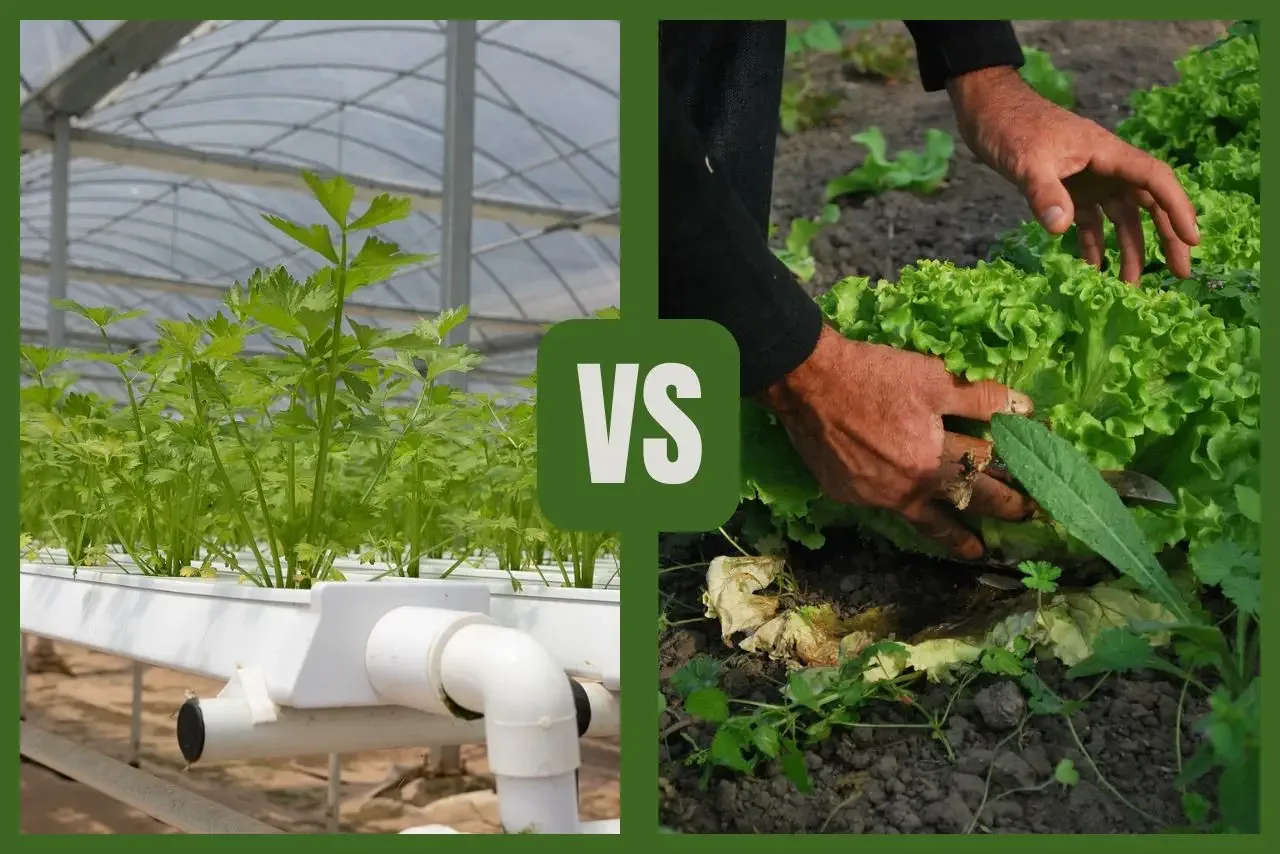
Hydroponics and traditional soil cultivation solve the same objective (producing food) using divergent biological delivery systems. Soil gardens buffer roots within a mineral and organic matrix, while hydroponic systems deliver dissolved salts directly in water.
This guide compares both cultivation methods across seven operational criteria: water consumption, spatial requirements, growth rate, startup expense, maintenance, crop variety, and resource efficiency.
For an introduction to system types and equipment, review our Complete Guide to Hydroponics for Beginners.
1. Water Usage
Hydroponics: Closed reservoirs recirculate water until absorbed by plant roots. By eliminating deep percolation into subsoil and surface evaporation, hydroponic systems consume up to 90% less water than field farming, according to Utah State University agricultural extension research.
Traditional Gardening: Soil beds lose moisture to deep drainage, weed transpiration, and surface evaporation. Soil requires regular overhead or drip irrigation, particularly in arid climates or during dry summer periods.
Summary: Hydroponics is significantly more water-efficient.
2. Space Requirements
Hydroponics: Root systems in nutrient baths remain compact because minerals are immediately accessible. Plants can be grouped tightly in horizontal gullies or vertical towers. This high density allows indoor cultivation on shelves, balconies, and inside garages.
Traditional Gardening: Plants require substantial lateral and vertical soil volume for root exploration. Outdoor plots demand dedicated yard space and suitable native topsoil.
If you are cultivating within an apartment footprint, our comparison of the best hydroponic systems for apartments evaluates operational noise, reservoir footprint, and odor management.
Summary: Hydroponics produces higher yields per square foot.
3. Growth Speed and Crop Yield
Hydroponics: Supplying ionic nutrients directly to roots accelerates vegetative development by 30% to 50% compared to field soil (as documented in peer-reviewed comparative cultivation trials). Controlled indoor photoperiods further shorten time to harvest.
Traditional Gardening: Plants must expand extensive root systems through mechanical soil resistance to locate mineral ions. Yields fluctuate with weather conditions, cloud cover, soil compaction, and insect pressure.
Summary: Hydroponics delivers faster crop turnaround and predictable seasonal yields.
4. Initial Setup and Capital Expense
Hydroponics: Assembling an indoor hydroponic setup requires an upfront investment in food-grade reservoirs, grow lights, digital pH and EC meters, and mineral concentrates.
Traditional Gardening: Basic outdoor soil beds require minimal startup capital: hand tools, compost amendments, and seed packets. However, recurring costs for organic amendments, irrigation water, and pest controls accumulate over multiple seasons.
If initial cost is your primary constraint, the passive Kratky method eliminates pumps and timers, allowing you to build a functional system for under $30.
For active aeration, a multi-bucket kit like the VIVOSUN Hydroponic 5-Gallon Bucket SystemView on Amazon bundles the reservoir, air pump, air stones, and net cup lids in a single package.
Summary: Soil gardening has lower startup costs; hydroponics delivers higher long-term efficiency where water is scarce.
5. Maintenance Demands and Daily Labor
Hydroponics: Eliminates tilling, weeding, and soil-borne pest management. Maintenance centers on measuring pH (5.5–6.5) and EC levels every 48 hours, alongside biweekly reservoir flushes. A digital pH and EC meter comboView on Amazon provides the necessary calibration accuracy.
Traditional Gardening: Demands regular physical labor: manual weeding, mulching, digging, stakes installation, and soil aeration. Environmental extremes (heat waves, hail, downpours) require protective row covers or emergency watering.
Summary: Hydroponics substitutes physical field labor with technical water monitoring.
6. Crop Variety and Morphological Compatibility
Hydroponics: Exceptional for leafy greens (lettuce, spinach, Asian greens), culinary herbs, strawberries, dwarf peppers, and indeterminate tomatoes. Large taproot vegetables (carrots, parsnips) and sprawling root tubers (potatoes) remain difficult to manage in standard fluid channels.
Traditional Gardening: Accommodates virtually all plant morphologies, including deep root crops, sprawling winter squash, perennial berry canes, and fruit trees.
Consult our selection of The Best Hydroponic Plants for Beginners for cultivars matched to water culture.
Summary: Traditional soil gardening accommodates a wider botanical variety.
7. Environmental Footprint
Hydroponics: Conserves water, eliminates agricultural runoff into local watersheds, and avoids synthetic soil insecticides. However, indoor systems consume electricity for artificial lighting and ventilation unless powered by solar arrays.
Traditional Gardening: Organic regenerative gardening builds living soil biomes and sequesters carbon in humus. Conversely, conventional gardening reliant on synthetic chemical pesticides and synthetic nitrogen fertilizers can degrade groundwater quality.
Summary: Hydroponics excels in water and land preservation; outdoor organic soil excels in zero electricity demand.
Conclusion
Choose hydroponics if you prioritize rapid harvests, water conservation, and year-round indoor production in limited space. Choose traditional soil beds if you have outdoor acreage, wish to grow deep root vegetables, or prefer gardening without artificial lighting and electrical pumps.
To test hydroponics with minimal initial commitment, construct a passive Kratky tote. If you are evaluating equipment choices, read our Complete Guide to Hydroponics for Beginners for full hardware specifications.
Editor’s Note: Parts of this guide were structured and optimized with the assistance of AI, then thoroughly reviewed, edited and expanded with first-hand growing experience by our author Raymond to ensure practical, real-world accuracy.
Frequently Asked Questions
Why does hydroponics grow plants faster than soil?
In soil, roots expend energy penetrating compacted dirt to search for minerals. In hydroponics, dissolved mineral ions bathe roots directly, allowing plants to direct metabolic energy into vegetative growth.
Is hydroponic gardening more expensive than soil gardening?
Upfront startup costs are higher for hydroponics due to containers, grow lights, meters, and nutrients. Over time, accelerated growth cycles and 90% water savings offset initial hardware expenses.
Our Amazon Storefront
Browse all our recommended tools & supplies
Everything we personally use and trust, hand-picked for gardeners like you.
I've been running DWC and Kratky systems for several years and write about what actually works, not textbook theory. Follow along for honest product reviews, practical guides and real grow results.