As an Amazon Associate, I earn from qualifying purchases. Some links in this article are affiliate links, if you buy through them I may earn a small commission at no extra cost to you.
Quick Summary
- Spring is a practical entry point: Expanding daylight and moderate ambient temperatures reduce heating and cooling demands on reservoirs.
- DWC is the easiest first system: Fewer moving parts and visible roots make diagnosing problems straightforward.
- Test the system empty first: Run the reservoir for 24 hours before adding plants to verify pump operation and catch leaks early.
- Start EC low: Keep solution at 0.6–0.8 mS/cm for young seedlings, stepping up concentration as root systems establish.
- Start with fast, forgiving crops: Leafy greens and culinary herbs let you dial in the system before committing to slower fruiting plants.
Spring is a natural starting point for indoor cultivation. The season works in your favor: natural photoperiods expand, reducing the energy demand on supplementary grow lights, and ambient room temperatures stabilize into the 65°F–75°F window that water culture systems prefer.
Here is a practical roadmap for launching your first hydroponic setup: system selection, essential gear, baseline water testing, and introductory crops.
Why Start in Spring
- Expanded Natural Light: Growing spaces near south- or west-facing windows receive significantly more usable ambient photons from March through May, easing the workload on secondary lighting.
- Moderate Ambient Temperatures: Hydroponic reservoirs perform best with solution temperatures between 65°F and 75°F (18°C to 24°C). Spring indoor conditions keep water in this range without requiring submersible tank heaters or dedicated water chillers.
- Seasonal Harvest Alignment: Setting up in spring yields early heads of salad greens and kitchen herbs right as outdoor gardens are still waiting on warm soil.
Choosing a System Type
| System | Complexity | Forgiveness | Best for |
|---|---|---|---|
| Deep Water Culture (DWC) | Low | High: roots visible, simple diagnosis | Beginners, leafy greens, herbs |
| Nutrient Film Technique (NFT) | Medium | Lower: pump failure dries roots quickly | Multi-plant horizontal layouts |
| Aeroponic towers | High | Lower: mist nozzles require frequent cleaning | Vertical spaces, compact footprints |
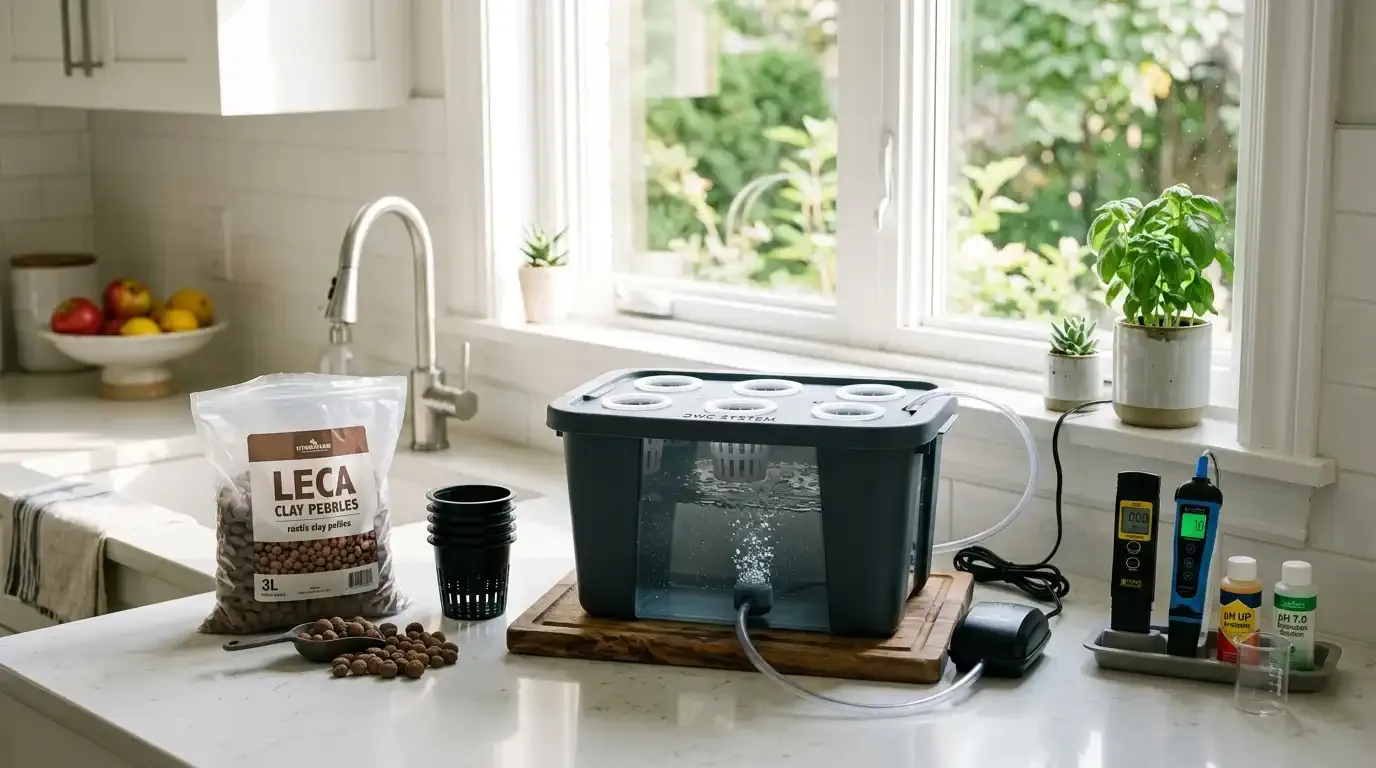
Deep Water Culture (DWC): The most accessible starting method. Plants sit in net pots supported by clay pebbles, with roots submerged in an oxygenated nutrient reservoir. It is easy to monitor and forgiving for beginners. For a zero-pump variant, read our guide to the easiest and cheapest hydroponic system.
Nutrient Film Technique (NFT): A shallow film of nutrient solution flows continuously down sloped gulley channels over bare root tips. NFT is highly productive for commercial salad greens, but any power outage dries out roots quickly.
Aeroponic Towers: Roots suspend in an internal column and receive automated nutrient mist cycles. Review our complete breakdown of how aeroponic towers work. Towers maximize vertical space, but clogged misting nozzles require quick intervention.
For a first spring setup, DWC remains the safest recommendation because inspecting roots simply requires lifting the net pot lid.
Essential Equipment Checklist
- Light-blocking reservoir bucket or tote with a fitted lid
- Net pots (2-inch or 3-inch sizes)
- Inert growing medium (expanded clay pebbles or rockwool plugs)
- Submersible air pump, silicone tubing, and air stone for aeration
- Hydroponic base nutrient formula
- Digital pH meter and pH Up/Down adjustment solutions
- Digital EC/TDS meter
- Full-spectrum LED grow light fixture
First Two Weeks: Setup Sequence
Days 1–3: The Wet Test Run Assemble the reservoir, plumb all airlines, fill with tap or reverse-osmosis water, and run the air pump for 24 hours with no plants in place. This verifies that fittings do not leak, air stones bubble evenly, and water temperatures remain stable.
Days 3–7: Introducing Seedlings Transfer rooted plugs into net pots filled with clay pebbles. Mix base nutrients to a dilute concentration of 0.6–0.8 mS/cm EC. Tender root tips burn easily if placed directly into adult nutrient strengths.
Week 2: Calibrating pH Drift Check pH daily during the second week. Fresh plastic reservoirs, new clay pebbles, and young root interactions cause water pH to wander. Adjust back to 5.8–6.2 as needed. For step-by-step correction instructions, read our guide on understanding hydroponic pH levels.
Selecting Your First Crops
For an initial run, select fast-growing spring vegetables rather than demanding vine crops. Butterhead lettuce, bok choy, and sweet basil mature in 30 to 45 days, teaching you how nutrient consumption and pH drift behave in your specific space. Once you complete one clean harvest cycle of greens, scaling up to tomatoes or cucumbers is much simpler.
Common First-Timer Mistakes
- Skipping the Dry/Wet Test: Discovering a split bucket seam or dead air pump after planting damages delicate roots. Always run equipment empty first.
- Overfeeding Young Starts: Adding full-strength vegetative fertilizer to unhardened seedlings stunts growth. Increase EC incrementally as the root mass expands.
- Checking pH Only Once: Reservoir chemistry shifts as plants drink water and release exudates. Regular testing prevents unnoticed nutrient lockout.
To integrate this setup into a broader seasonal garden, review our full spring gardening guide.
Frequently Asked Questions
Is spring a good time to start hydroponics?
Yes. Increasing daylight reduces reliance on grow lights, and ambient indoor temperatures sit closer to the 65°F–75°F range most systems require without supplemental heaters or chillers.
Which hydroponic system is best for a first-time grower?
Deep Water Culture (DWC) is the most straightforward starting point. It has minimal moving parts, is simple to troubleshoot, and lets you inspect roots directly.
What EC should I start with for new hydroponic seedlings?
Start low, around 0.6–0.8 mS/cm EC for most leafy greens and herbs. Young roots are sensitive to high salt concentrations, so ramp up gradually as plants mature.
Our Amazon Storefront
Browse all our recommended tools & supplies
Everything we personally use and trust, hand-picked for gardeners like you.

I've been running DWC and Kratky systems for several years and write about what actually works, not textbook theory. Follow along for honest product reviews, practical guides and real grow results.