As an Amazon Associate, I earn from qualifying purchases. Some links in this article are affiliate links, if you buy through them I may earn a small commission at no extra cost to you.
Quick Summary
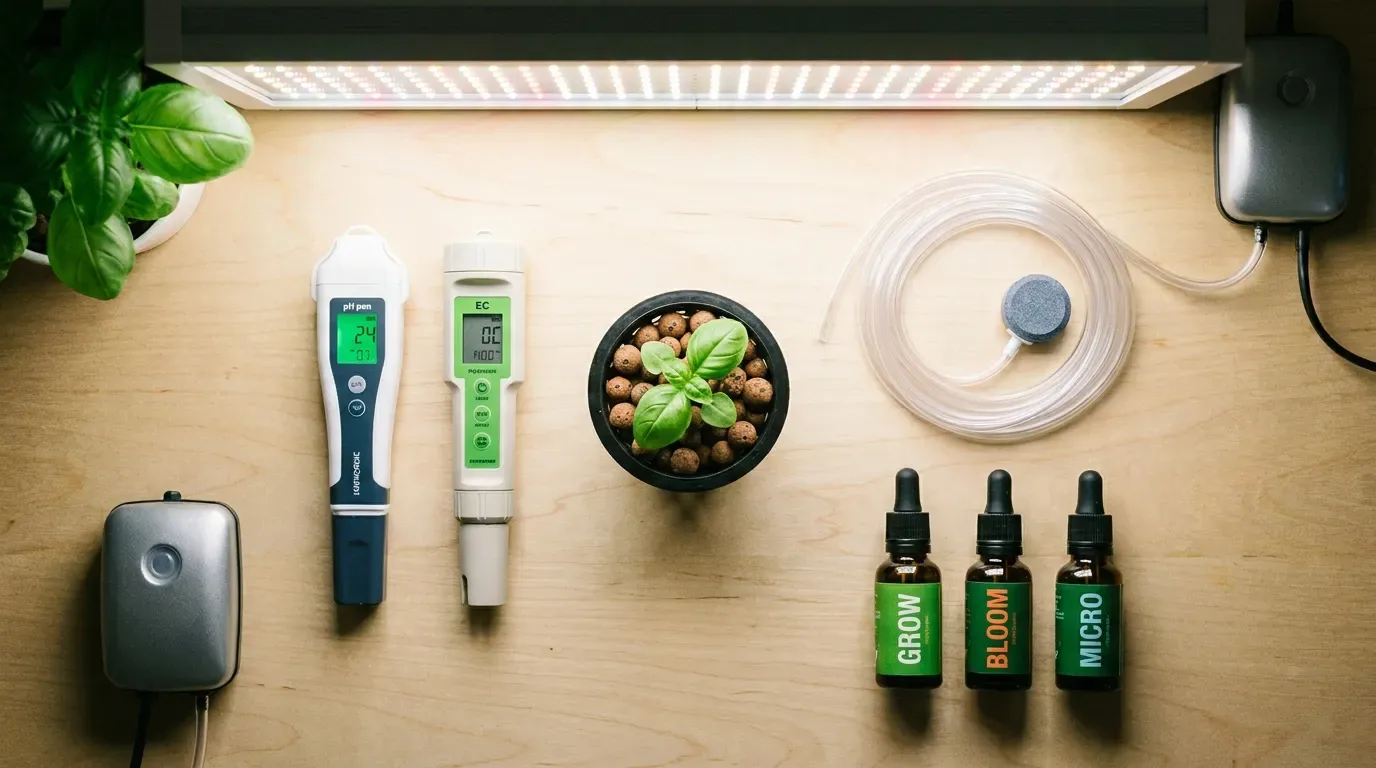
- Core Meters: Use glass-electrode pH and electrical conductivity (EC) meters to verify nutrient solution chemistry.
- Lighting Fixtures: Full-spectrum LED panels provide photon output without excessive thermal radiation.
- Pumps & Aerators: Aerate reservoirs using diaphragm air pumps and circulate feeds using submersible water pumps.
- Inert Substrates: Select expanded clay pebbles for DWC and drip systems, coco coir for moisture, or rockwool for plugs.
- Reservoirs: Use light-blocking, food-grade polyethylene containers sized to buffer chemical drift.
- Digital Timers: Automate daily photoperiods and flood intervals on 24-hour cycles.
A hydroponic toolkit provides the measurement and delivery hardware required to regulate water, light, and ionic nutrition. Because soilless culture lacks the chemical buffer of native earth, accurate diagnostic instruments prevent crop failures from nutrient lockout and root suffocation.
Quick Reference Tool Guide
| Tool Name | Primary Function | Necessity |
|---|---|---|
| 1. Grow Lights | Deliver photons for photosynthetic carbon fixation | Essential (indoor) |
| 2. Growing Medium | Anchor root crowns and maintain gas exchange | Essential |
| 3. Nutrient Solution | Supply soluble mineral ions (N-P-K and micros) | Essential |
| 4. pH Meter | Measure hydrogen ion concentration (5.5–6.5) | Essential |
| 5. EC Meter | Measure dissolved mineral salt concentration | Essential |
| 6. Air Pump & Stones | Dissolve atmospheric oxygen into liquid baths | Essential (DWC) |
| 7. Submersible Pump | Circulate nutrient solution through plumbing | Essential (active systems) |
| 8. Opaque Reservoir | Store and protect nutrient solution from light | Essential |
| 9. Digital Timers | Automate photoperiods and irrigation cycles | Essential |
| 10. Thermo-Hygrometer | Track vapor pressure deficit, temp, and humidity | Recommended |
1. Grow Lights
Indoor hydroponic crops require artificial fixtures supplying photosynthetically active radiation (PAR). Inadequate photon flux results in elongated, weak stems (etiolation), while fixtures mounted too close cause thermal bleaching and leaf scorch.
Full-spectrum LED fixtures delivering 4000K–6500K wavebands provide high photon efficacy per watt. Look for fixtures utilizing high-efficiency diodes (such as Samsung LM301) rather than narrow-band red/blue arrays. Our analysis of the best LED grow lights for beginners lists tested wattage ratings by canopy footprint.
Fluorescent T5 tubes work well for early seedling propagation, but lack the photon intensity required to mature heavy fruiting crops.
2. Growing Medium
Soilless substrates physically anchor the plant stem while permitting root aeration and moisture drainage:
- Expanded Clay Pebbles (LECA): Kiln-fired clay balls providing continuous drainage and aeration. Ideal for DWC net pots and flood-and-drain beds. Clay pelletsView on Amazon are reusable after chemical sterilization.
- Rockwool: Spun basalt fibers holding high moisture volumes with uniform porosity. Soak in pH 5.5 water prior to seeding to neutralize alkaline residues.
- Coco Coir: Shredded coconut husk fiber offering high moisture retention for leafy greens. Supplement with calcium and magnesium to offset cation binding. Coco coirView on Amazon blends well with perlite.
- Vermiculite: Exfoliated mica that wicks moisture in germination plugs. VermiculiteView on Amazon maintains seed moisture without compacting.
3. Hydroponic Mineral Nutrients
Hydroponic plants depend entirely on dissolved hydroponic nutrientsView on Amazon for primary macronutrients (nitrogen, phosphorus, potassium), secondary elements (calcium, magnesium, sulfur), and chelated micronutrients.
Use dedicated hydroponic mineral formulations. Standard agricultural fertilizers contain urea and insoluble compounds that require microbial decomposition unavailable in liquid water baths. Multi-part lines (such as General Hydroponics Flora Series) allow separate dosing for vegetative and flowering phases.
4. Digital pH Meter and Adjusters
Reservoir pH controls the chemical solubility of dissolved minerals. Maintain solution pH between 5.5 and 6.5. Outside this band, iron, phosphorus, and zinc precipitate into unusable forms. Consult our guide on managing hydroponic pH levels to evaluate lockout chemistry.
Use a glass-electrode digital pH meter with automatic temperature compensation. Paper indicator strips lack the resolution to detect critical 0.2 pH drifts. Dilute concentrated pH Up (potassium hydroxide) or pH Down (phosphoric acid) in plain water before dosing the reservoir.
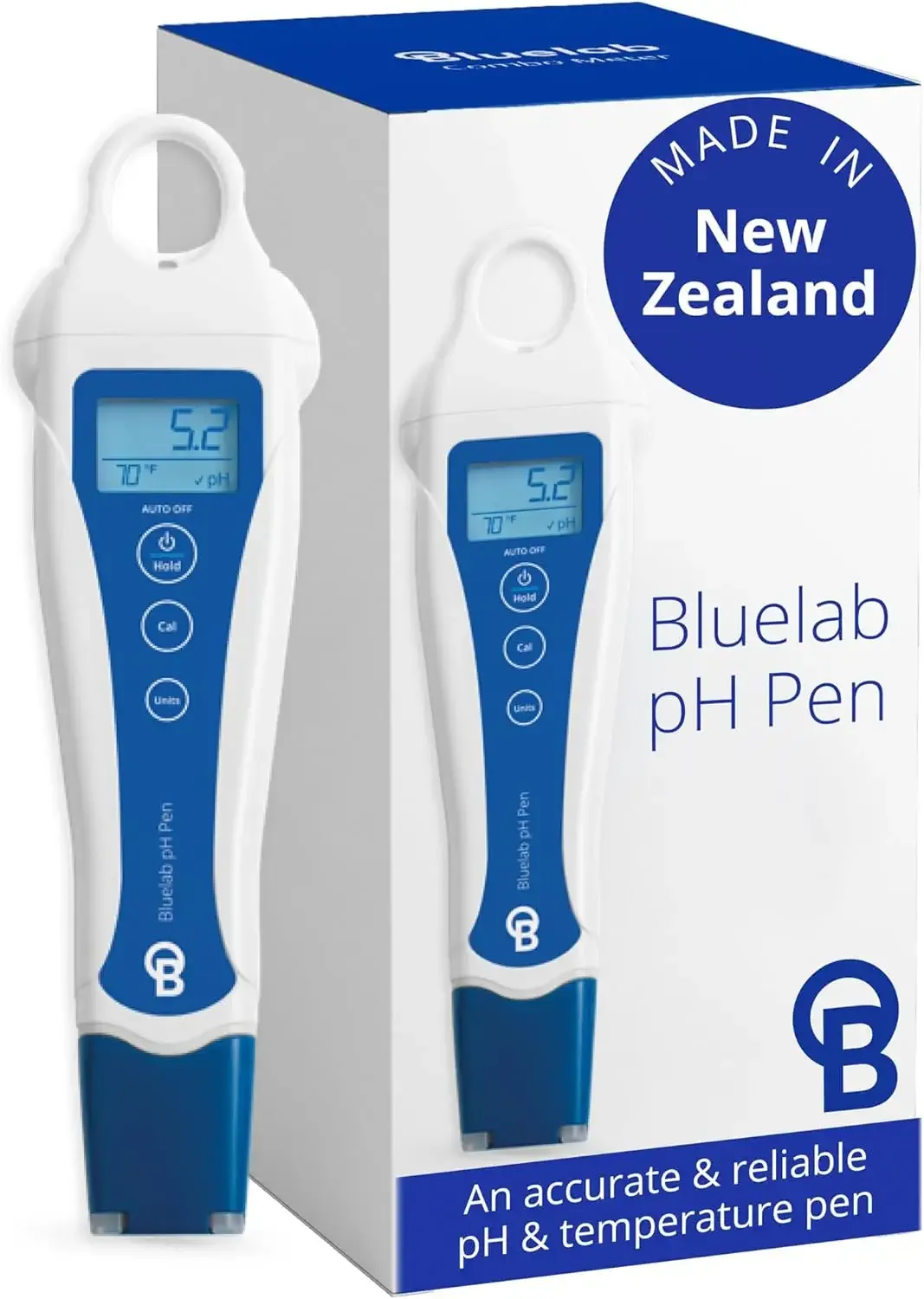
Bluelab pH Pen
Commercial-grade digital pH pen featuring a double-junction glass probe, automatic temperature compensation, and two-point calibration. Built in a waterproof housing for daily reservoir testing.
5. EC / TDS Conductivity Meter
An Electrical Conductivity (EC) meterView on Amazon measures the concentration of dissolved mineral ions in solution. Measuring conductivity prevents salt toxicity (nutrient burn) and chronic mineral underfeeding.
Standard EC pens hold calibration reliably across multiple crop cycles. Track conductivity in milliSiemens per centimeter (mS/cm): maintain leafy greens between 0.8 and 1.4 mS/cm, increasing to 1.8–2.5 mS/cm for heavy-feeding tomatoes and peppers.
6. Diaphragm Air Pump and Air Stones
Deep Water Culture systems require continuous mechanical aeration using hardware like the VIVOSUN Air Pump KitView on Amazon. Aeration maintains dissolved oxygen levels above 6 mg/L, preventing anaerobic conditions that foster Pythium water molds. Review our technical analysis of air pumping in hydroponics.
Select a pump supplying at least 1 liter per minute of airflow per 4 liters of reservoir volume. Position micro-pore diffuser stones across the container base to eliminate stagnant water pockets.
7. Submersible Water Pump
Active systems (NFT, Ebb and Flow, drip irrigation) require a submersible utility pump, such as the VIVOSUN Submersible PumpView on Amazon, to lift solution into cultivation channels.
Size pumps based on total fluid volume and vertical head height. A pump circulating the full reservoir volume once to twice per hour provides an operational baseline. Keep an identical spare pump on hand; active systems desicate roots within hours if circulation halts.
8. Opaque Reservoir
The reservoirView on Amazon holds the bulk nutrient solution before distribution. Larger water volumes buffer against rapid swings in temperature, electrical conductivity, and pH.
Use food-grade high-density polyethylene (HDPE) or polypropylene containers that block 100% of ambient light. Light penetration spurs rapid algae blooms that deplete dissolved oxygen and foul pump impellers. Allow at least 2 gallons (7.5 liters) of water capacity per mature plant site.
9. Digital Timers and Automation
Digital appliance timersView on Amazon automate photoperiods and irrigation cycles. Photoperiod consistency prevents premature floral initiation in vegetative greens.
Digital timers preserve program memory during power outages and support minute-by-minute interval cycles necessary for flood-and-drain systems.
10. Digital Thermo-Hygrometer
Thermo-hygrometers track ambient air temperature and relative humidity, allowing growers to manage vapor pressure deficit (VPD). Keep ambient grow room temperatures between 20°C and 25°C (68°F–77°F). Maintain nutrient solution temperatures between 18°C and 21°C (64°F–70°F) to preserve dissolved oxygen retention.
Conclusion
Begin with the core diagnostic baseline: a calibrated digital pH meter, an EC pen, an air pump with diffuser stones, and full-spectrum LED fixtures. Master reservoir water chemistry on simple systems before introducing automated flood timers and multi-line drip manifolds.
Editor’s Note: Parts of this guide were structured and optimized with the assistance of AI, then thoroughly reviewed, edited and expanded with first-hand growing experience by our author Raymond to ensure practical, real-world accuracy.
Frequently Asked Questions
Why is a pH meter essential in hydroponics?
A pH meter measures hydrogen ion concentration in solution. Plants absorb dissolved minerals within a narrow pH range (5.5 to 6.5); outside this band, mineral ions precipitate into insoluble forms, causing nutrient lockout.
What is the function of an EC meter?
An EC (Electrical Conductivity) meter measures the density of dissolved mineral salts, preventing fertilizer under-feeding and osmotic root scorch.
What is the best hydroponic system for a beginner?
Single-bucket Deep Water Culture (DWC) and passive Kratky setups offer the simplest configurations. Kratky requires zero electrical hardware and suits fast-cycling leafy greens and herbs.
How often should I check pH and EC?
Test pH and EC daily for the initial two weeks of a new reservoir charge, then test every 48 hours once drift stabilizes. Test more frequently during warm summer periods when transpiration rates spike.
Do I need a timer for my hydroponic system?
Yes. Digital timers regulate 14- to 16-hour photoperiods without manual intervention. Active drip and flood-and-drain configurations also require interval cycle timers.
Our Amazon Storefront
Browse all our recommended tools & supplies
Everything we personally use and trust, hand-picked for gardeners like you.

I've been running DWC and Kratky systems for several years and write about what actually works, not textbook theory. Follow along for honest product reviews, practical guides and real grow results.