As an Amazon Associate, I earn from qualifying purchases. Some links in this article are affiliate links, if you buy through them I may earn a small commission at no extra cost to you.
Quick Summary
- Core Difference: Aeroponics suspends roots in open air and mists them on a timed cycle. NFT runs a thin, continuous film of nutrient solution past roots that stay mostly exposed to air.
- Failure Tolerance: Aeroponics is the least forgiving of the two, roots have zero moisture buffer between mist cycles. NFT’s thin film offers a slightly longer window before roots stress.
- Best For Cloning: Aeroponics is well suited to cloning cuttings, the constant oxygen exposure encourages fast root development on a stem that has no roots yet.
- Space and Cost: NFT is usually cheaper to build and easier to maintain. Aeroponics costs more upfront and needs more attention to prevent clogging.
- Best Plants: Both suit lightweight, shallow-rooted plants, lettuce, herbs, strawberries, not larger fruiting crops.
Aeroponics and Nutrient Film Technique (NFT) are two advanced hydroponic systems that operate without submerging roots in standing reservoirs. Instead, they supply water, oxygen, and minerals through pressurized misting or continuous shallow laminar flow.
Both configurations isolate root systems from stagnant water to maximize oxygen absorption. However, eliminating standing water also removes the thermal and hydration buffer provided by traditional tanks, meaning equipment failures require immediate correction.
How Aeroponics Operates
In a true aeroponic setup, roots hang unanchored in a light-sealed chamber without loose aggregate. A high-pressure pump forces nutrient solution through atomizing nozzles on a synchronized cycle, coating root filaments in 30-to-80-micron droplets.
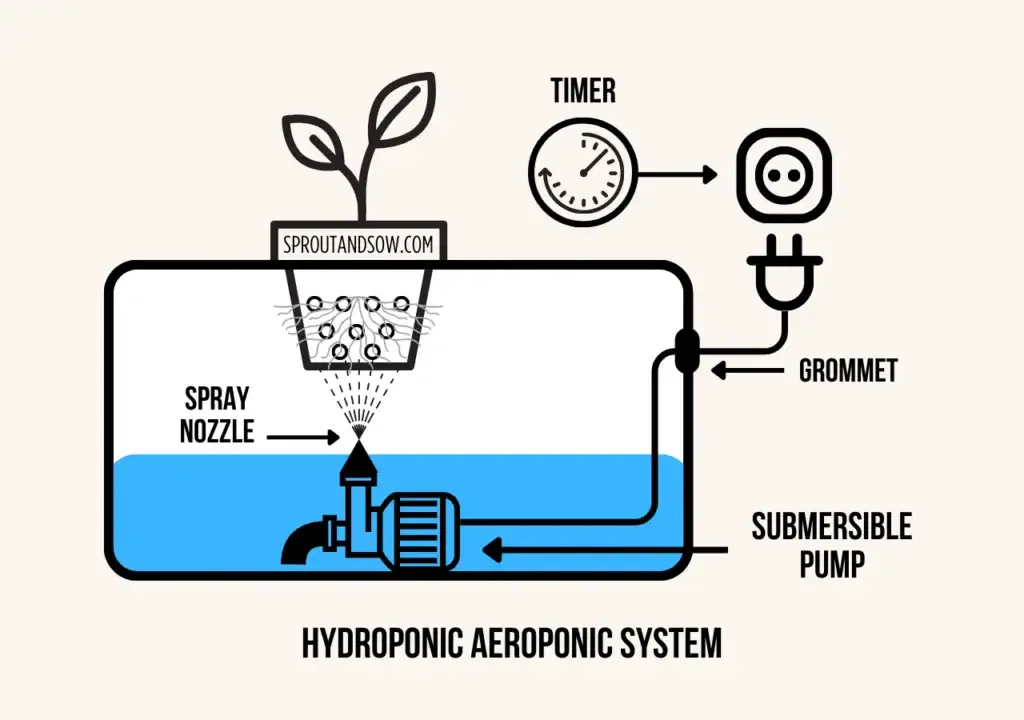
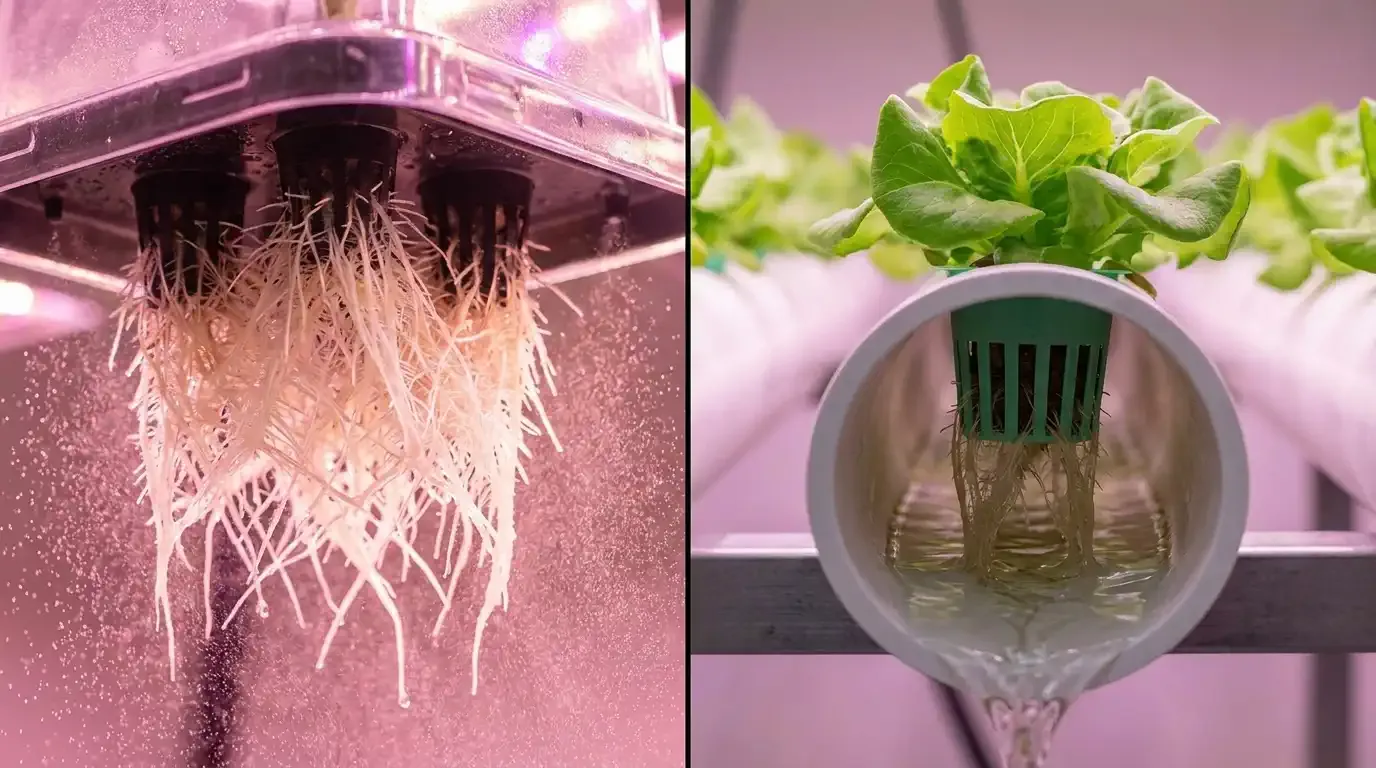
Direct exposure to atmospheric oxygen between misting intervals accelerates root metabolism. Intermittent misting (such as 30 seconds of spray every 3 to 5 minutes) maintains high humidity around roots while preventing saturation that limits gas exchange.
System Classifications
Many desktop towers sold as “aeroponic” run low-pressure submersible pumps that trickle water down internal walls. Commercial aeroponics utilizes high-pressure pumps (80+ PSI) to produce atomized fogs. Learn about structural differences and flow rates in our complete guide to aeroponic towers.
Applications for Propagation
Aeroponics excels in vegetative cloning. Freshly cut plant stems develop root primordia rapidly when suspended in warm, oxygen-saturated mist chambers without damp soil aggregates that harbor fungal spores.
How Nutrient Film Technique Operates
NFT approaches root aeration through gravity flow. Rather than spraying roots in mid-air, plants sit in rigid, shallow channels sloped at a 1:30 to 1:40 gradient. A pump continuously delivers a thin layer of nutrient water across the channel floor.
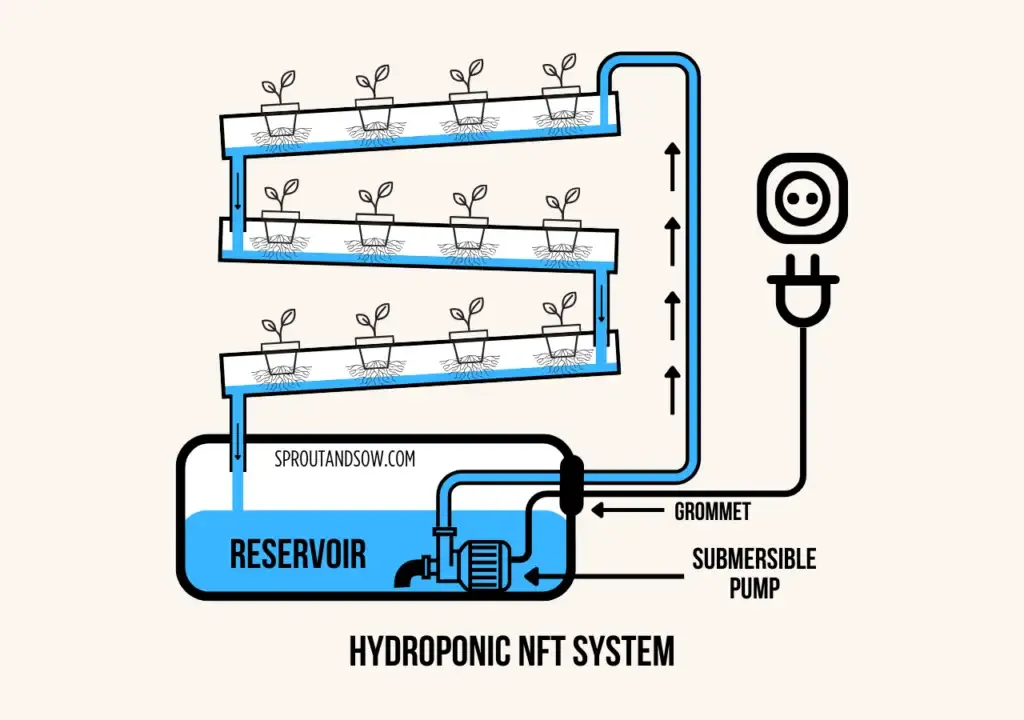
The lower layer of the root mass rests in the passing liquid, absorbing dissolved mineral ions, while the upper root structure remains exposed to moist air inside the channel cavity.
While NFT avoids the fine misting nozzles that clog in aeroponics, it remains pump-dependent: if flow stops, the shallow stream drains within seconds, leaving roots vulnerable to drying.
Side-by-Side Comparison
| Factor | Aeroponics | Nutrient Film Technique (NFT) |
|---|---|---|
| Root environment | Suspended in air; pulsed mist cycles | Lower roots in shallow film; upper roots in air |
| Buffer time during pump failure | Under 15 minutes before wilting begins | 15–30 minutes before wilting begins |
| Propagation utility | Industry standard for aeroponic cloner manifolds | Rarely used for unrooted cuttings |
| Equipment expense | Higher (pressure pumps, solenoid valves, mist tips) | Lower (standard submersible pumps, PVC channels) |
| Maintenance demands | High (frequent nozzle descaling and line flushes) | Moderate (channel flushing and algae checks) |
| Compatible crops | Fast-turnover greens, herbs, strawberries | Fast-turnover greens, herbs, strawberries |
| Spatial layout | Vertical columns and cylindrical towers | Horizontal linear gullies and tiered A-frames |
Operational Challenges
Both systems require active mechanical delivery. A power outage or pump failure that lasts several hours can destroy an entire crop.
Aeroponics
Nozzle clogging is the primary point of failure. Dissolved calcium and phosphorus precipitate around micro-orifices, reducing droplet output. Using reverse osmosis water and scheduling periodic vinegar flushes prevents mineral accumulation.
NFT
Root damming poses the main threat. As root masses expand, dense root mats can block channel drainage, causing nutrient water to pool. Stagnant pools deplete dissolved oxygen and trigger root rot. Trim root growth or harvest crops before canopies become overgrown.
Important
Outage Protection: Because neither system holds a water reserve, connect pumps to a battery backup (UPS) or configure smart plugs with automated outage notifications.
System Selection Guidance
For growers new to hydroponics, passive systems like the Kratky method or basic Deep Water Culture (DWC) offer greater tolerance for minor timing and nutrient errors.
If you are expanding beyond DWC to high-volume leafy green production, review our comparison of NFT versus Deep Water Culture. Choose NFT for continuous commercial channels, or aeroponics for vertical footprint efficiency and cutting propagation.
Solution Monitoring
Because low-volume systems lack large water buffers, plant transpiration alters mineral concentrations rapidly. Measure EC and pH daily to prevent fertilizer toxicity or nutrient lockouts. Consult our EC and pH reference guide for target parameters by crop species.
Editor’s Note: Parts of this guide were structured and optimized with the assistance of AI, then thoroughly reviewed, edited and expanded with first-hand growing experience by our author Raymond to ensure practical, real-world accuracy.
Frequently Asked Questions
Which system fails faster if the power goes out, aeroponics or NFT?
Aeroponics fails faster. Roots hang in empty air between mist intervals, so an outage cuts off moisture instantly. NFT channels retain a shallow residual film that buys 15 to 30 minutes of moisture, though neither method tolerates prolonged power loss.
Is aeroponics actually better for cloning than other methods?
Yes. High-humidity chambers combined with continuous oxygen exposure encourage cut stems to form adventitious roots rapidly, which is why commercial nurseries use dedicated aeroponic cloning manifolds.
Which is cheaper to build, NFT or aeroponics?
NFT is cheaper to construct. It requires standard low-pressure submersible pumps and simple drainage channels, whereas aeroponics demands high-pressure pumps, accumulator tanks, and specialized misting nozzles that require regular descaling.
Can either system support larger fruiting plants like tomatoes?
Neither system accommodates mature vining crops well. Large fruiting plants produce dense, heavy root systems that obstruct shallow NFT channels and overwhelm vertical mist chambers. Deep Water Culture or Dutch buckets are better choices for heavy crops.
Our Amazon Storefront
Browse all our recommended tools & supplies
Everything we personally use and trust, hand-picked for gardeners like you.

I've been running DWC and Kratky systems for several years and write about what actually works, not textbook theory. Follow along for honest product reviews, practical guides and real grow results.