As an Amazon Associate, I earn from qualifying purchases. Some links in this article are affiliate links, if you buy through them I may earn a small commission at no extra cost to you.
Quick Summary
- System Breakdown: Compare DWC, NFT, Ebb & Flow, Drip, and Wick configurations.
- Deep Water Culture: Submerge plant roots directly in a continuously aerated nutrient reservoir.
- Nutrient Film Technique: Circulate a shallow, continuous stream of nutrient solution over roots in sloped channels.
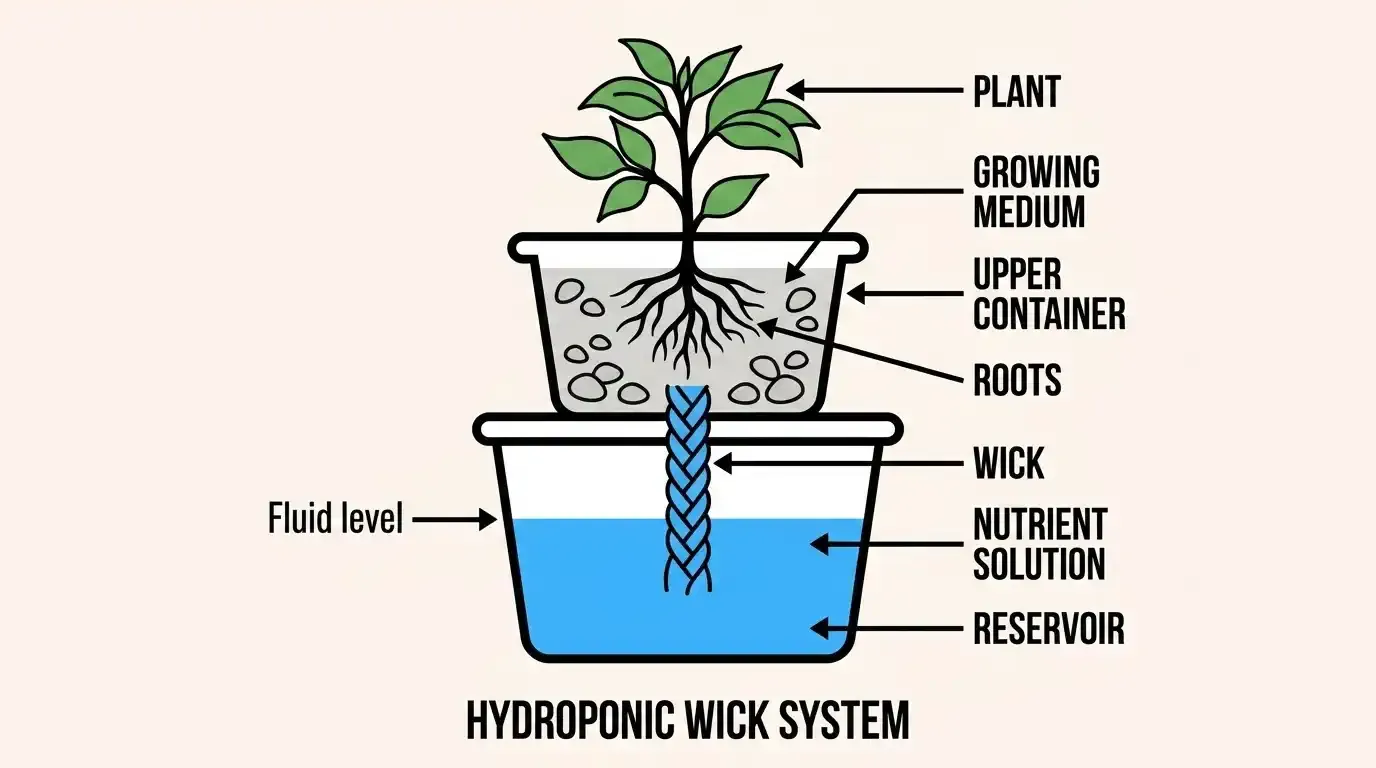
- Wick System: Rely on passive fabric wicks to draw solution from a reservoir into growing media.
- Ebb and Flow: Flood root trays on automated timer cycles using a submersible pump.
Hydroponic systems deliver water and dissolved fertilizer directly to plant root zones. System architectures vary in plumbing complexity, oxygenation mechanisms, and maintenance demands.
This guide compares five primary hydroponic designs: Deep Water Culture (DWC), Nutrient Film Technique (NFT), Ebb and Flow, Drip systems, and Wick systems.
For an overview of nutrient chemistry, lighting, and seed starting, review our Complete Guide to Hydroponics for Beginners.
1. Deep Water Culture (DWC)
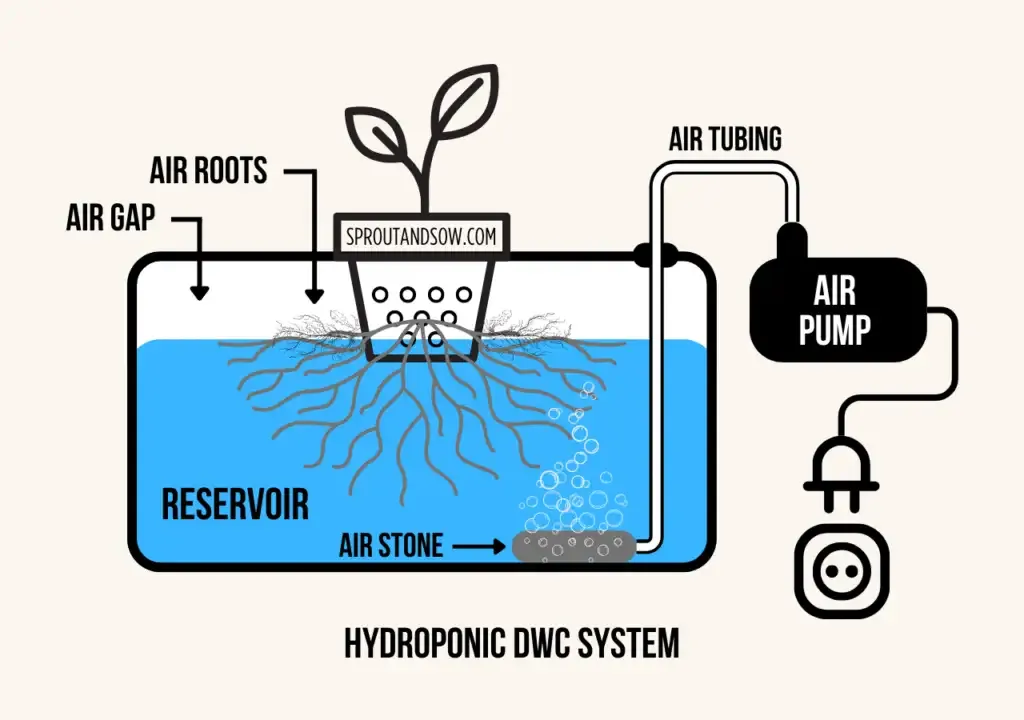
Deep Water Culture suspends plant net pots above a reservoir, keeping root systems fully submerged in nutrient solution. An electric air pump connected to an air stone diffuses oxygen into the water 24 hours a day. The passive Kratky System operates on similar principles but eliminates the air pump by using a receding water level to form an air gap.
Mechanics: Plants sit in net cups filled with expanded clay pebbles. Roots descend through the mesh into the aerated bath below. Continuous bubbling prevents water stagnation and root suffocation.
Target Crops: Leafy greens (lettuce, spinach, kale) and herbs (basil, mint). Larger 5-gallon DWC buckets support fruiting crops like cherry tomatoes and bell peppers.
Advantages:
- Minimal moving parts and simple plumbing.
- Rapid root growth due to direct oxygenation.
- Low daily maintenance once reservoir chemistry stabilizes.
Limitations:
- Requires uninterrupted electrical power for aeration.
- Warm water (above 20°C / 68°F) invites rapid Pythium (root rot) outbreaks.
Operational Rule: Maintain water temperatures between 18°C and 20°C (65°F–68°F). Keep reservoirs in temperature-controlled spaces or shield them from direct radiant heat.
2. Nutrient Film Technique (NFT)
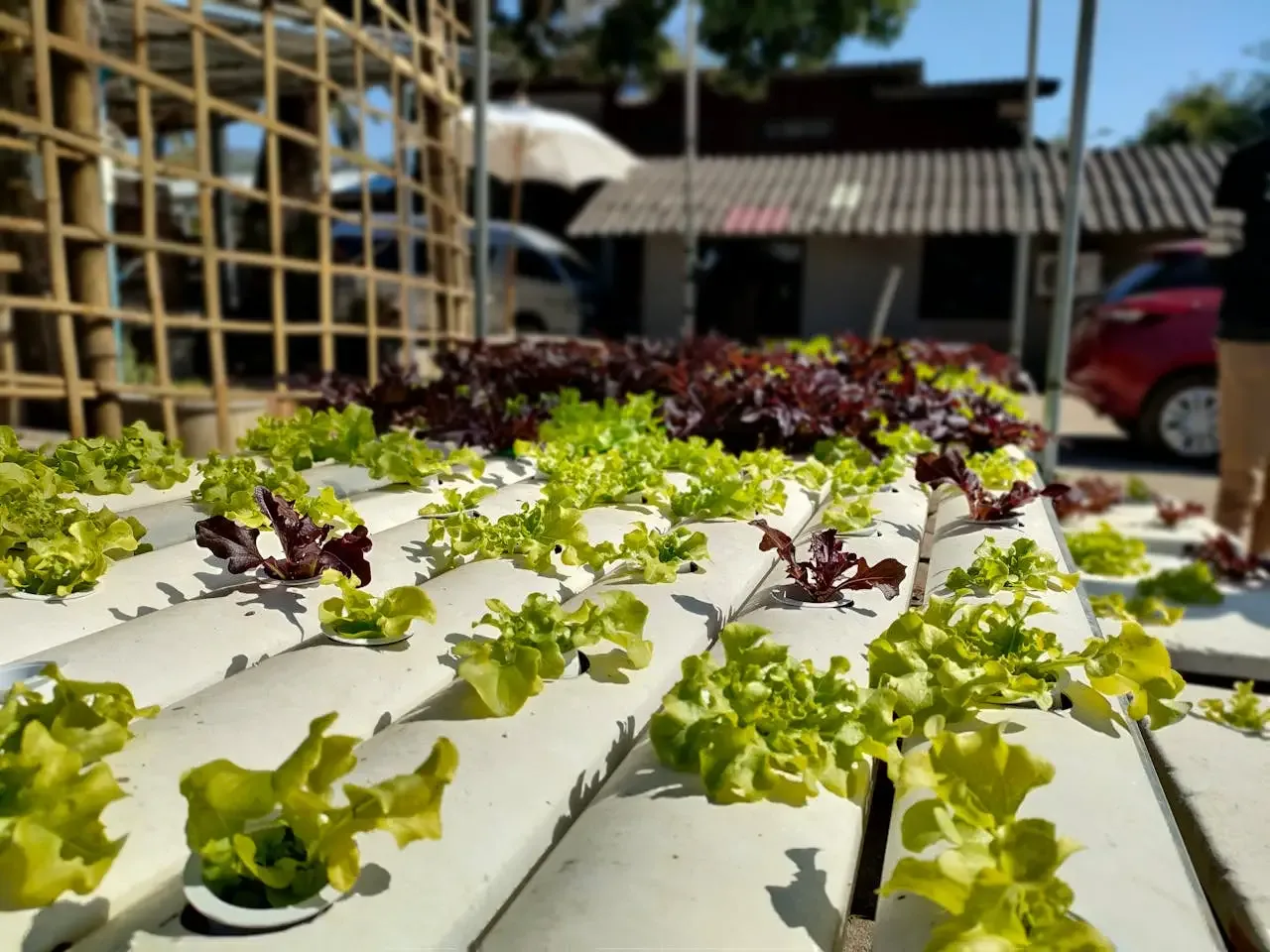
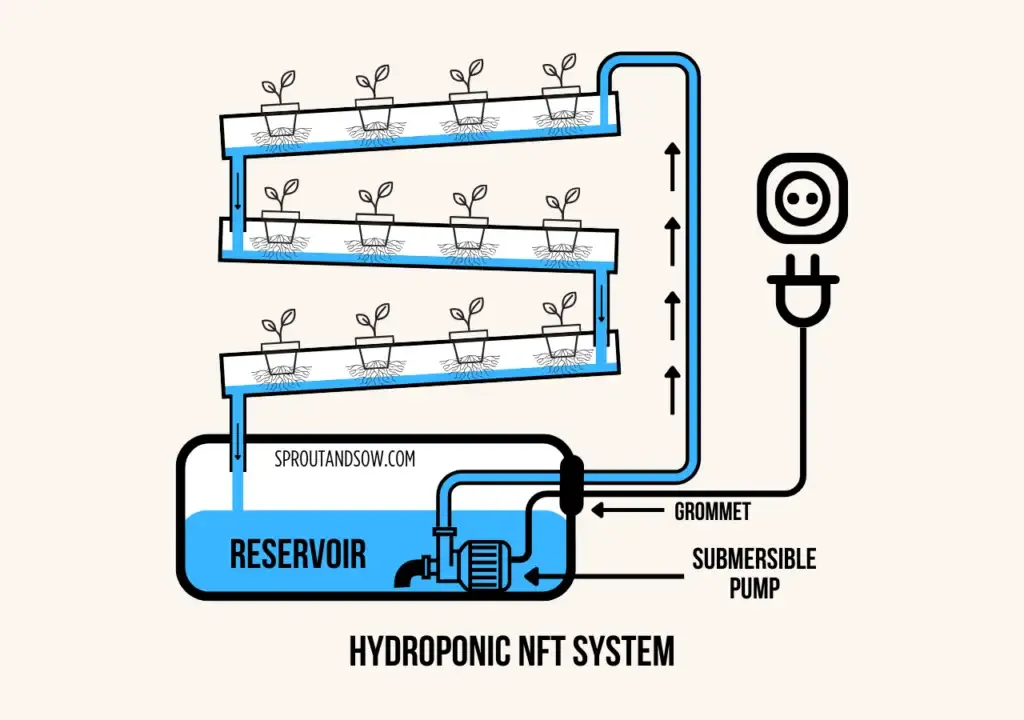
The Nutrient Film Technique circulates a continuous, shallow stream of nutrient solution along the bottom of a rigid, food-grade PVC or polypropylene channel.
Mechanics: A submersible pump sends solution to the high end of a sloped gully. Gravity pulls the liquid down the channel across the root mats, draining back into the reservoir for recirculation. Roots absorb dissolved ions from the liquid film and oxygen from the humid channel airspace.
Target Crops: High-density leafy greens, strawberries, and small culinary herbs. Unsuited to heavy brassicas or deep taproots that dam the channel.
Advantages:
- Low water volume in circulation reduces overall reservoir weight.
- Excellent root oxygenation inside the humid channel chamber.
- Efficient modular footprint for vertical or tiered layouts.
Limitations:
- Pump failure or power loss dries out roots within several hours.
- Roots can clog drainage fittings if crops are left unharvested too long.
Operational Rule: Set channel slope at 1:30 to 1:40 (roughly 2.5 to 3 cm of drop per meter of channel). Inadequate slope causes puddling, which suffocates lower root tissue.
For an in-depth breakdown of these two active methods, see our NFT vs. DWC comparison.
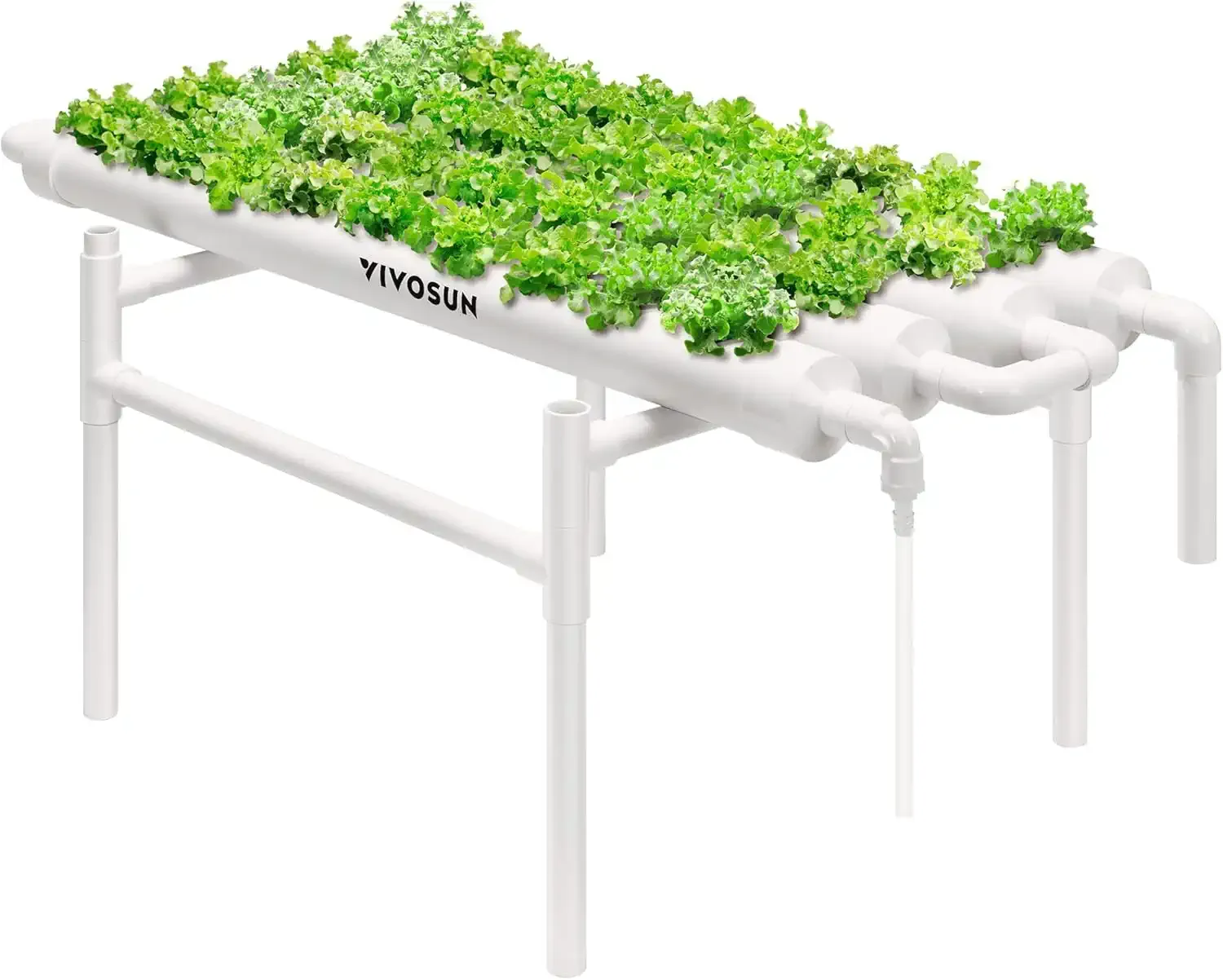
VIVOSUN NFT Hydroponic Grow System
A 36-plant horizontal pipe NFT kit complete with food-grade PVC channels, submersible pump, net cups, and starter sponge plugs. Fits balconies and indoor growing spaces.
3. Ebb and Flow (Flood and Drain)
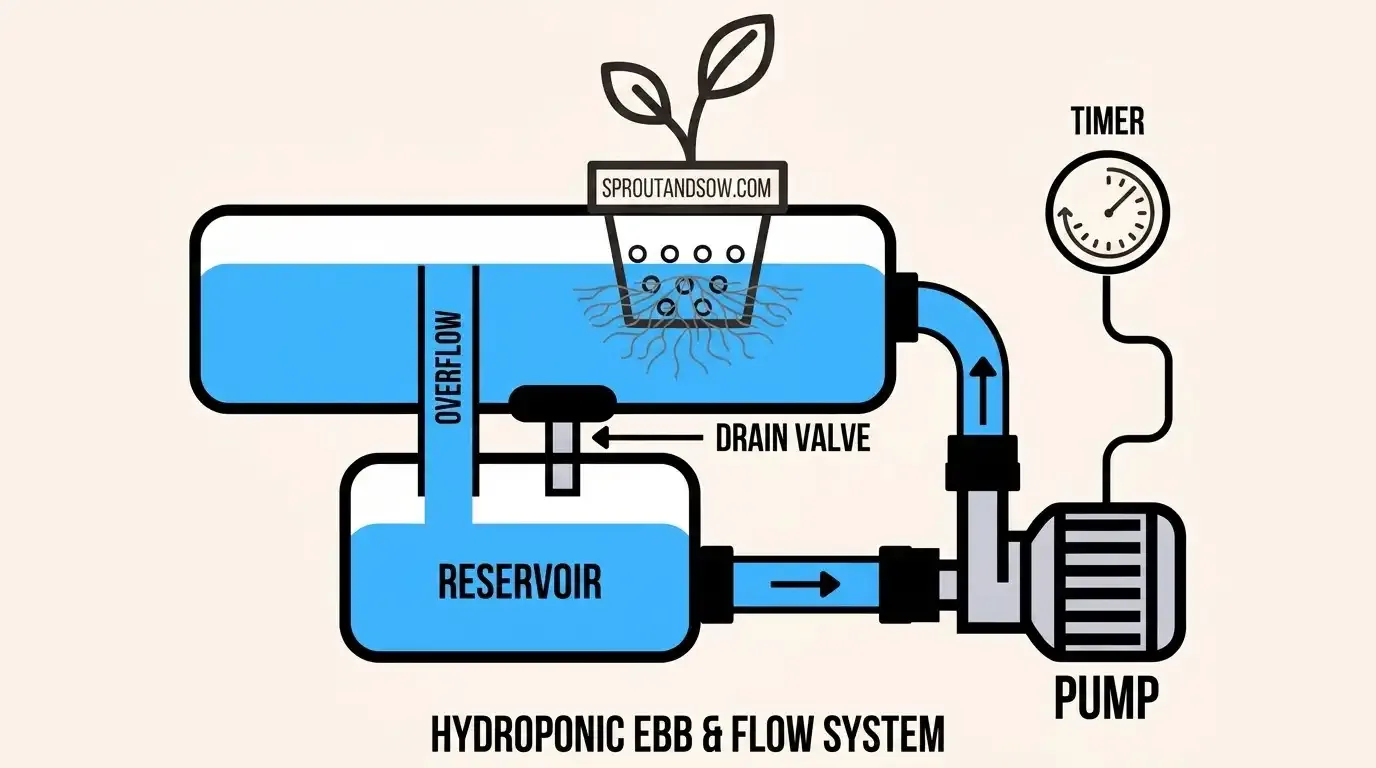
Ebb and Flow systems flood the plant root zone with nutrient solution on scheduled intervals, then drain the liquid completely back into the lower reservoir.
For cycle timing and plumbing siphon schematics, review our dedicated ebb and flow guide.
Mechanics: Plants sit in a shallow flood tray filled with porous media (expanded clay pebbles). A timer activates a submersible pump, raising the water level until it reaches an overflow drain fitting. When the timer turns off, solution drains back into the reservoir via gravity, pulling fresh air into the media pore spaces.
Target Crops: Adaptable to diverse crops: herbs, leafy greens, root brassicas, tomatoes, and peppers.
Advantages:
- Accommodates mixed plant sizes in standard nursery pots or loose media beds.
- Draining phase forces oxygen deep into the root substrate.
- Tolerant of minor pump delays because media retains residual moisture.
Limitations:
- Requires dependable mechanical or digital timers.
- Drain fittings can become clogged by loose substrate particles.
Operational Rule: When using expanded clay pebbles, run 15-minute flood cycles 4 to 6 times daily. For rockwool slabs, reduce cycles to 2 or 3 times daily to prevent waterlogging.
4. Drip Systems
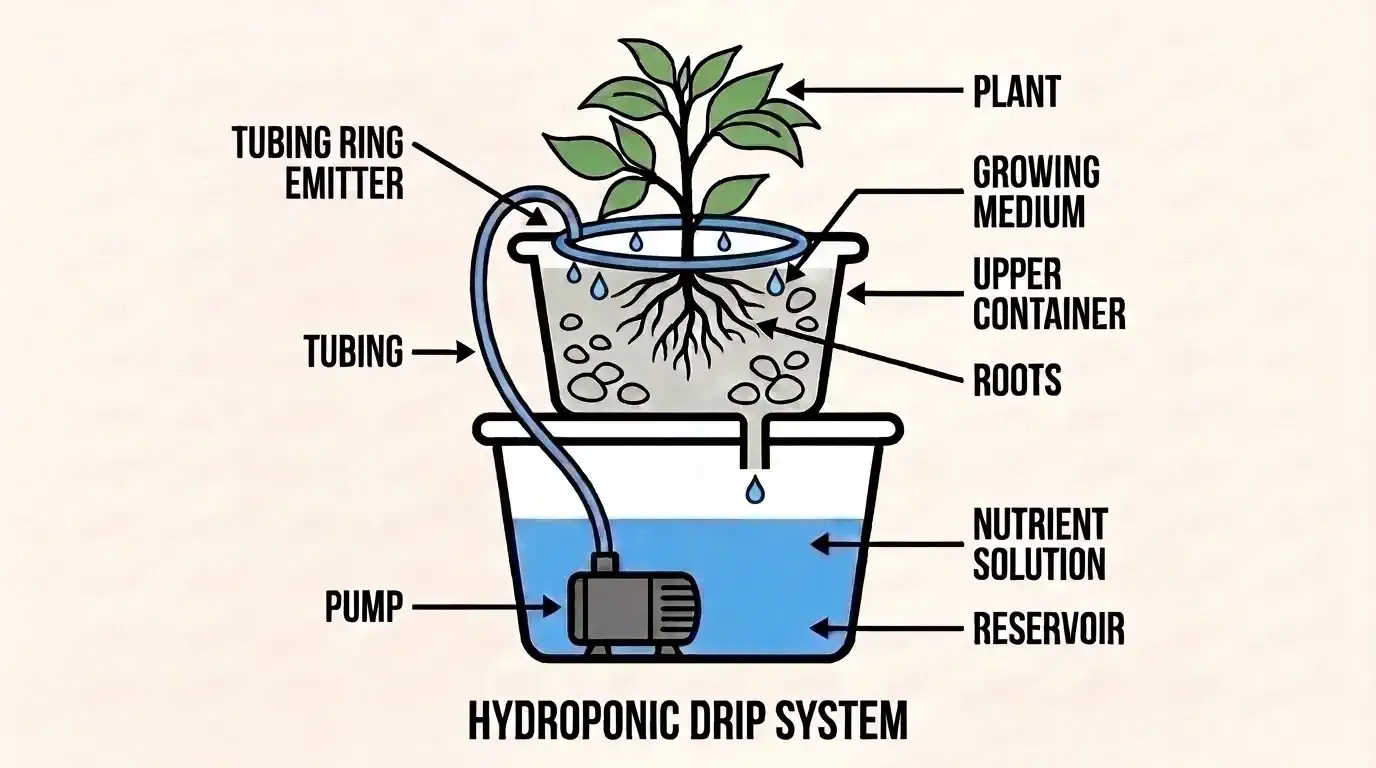
Drip systems deliver nutrient solution directly to the base of individual plants through narrow micro-tubing and calibrated drip emitters.
Our step-by-step drip system guide outlines reservoir sizing, emitter flow ratings, and cycle scheduling.
Mechanics: A high-pressure submersible pump pushes solution through supply manifolds to individual emitters positioned at plant root crowns. Systems operate either as recovery (excess drainage recirculates) or non-recovery (run-to-waste).
Target Crops: Large, long-season fruiting crops such as indeterminate tomatoes, cucumbers, eggplants, and squash.
Advantages:
- Independent water delivery allows precise flow control per plant site.
- Highly scalable from single containers to multi-bench commercial facilities.
- Compatible with various media (coco coir, perlite, rockwool).
Limitations:
- Drip emitters clog easily with mineral salt deposits or organic debris.
- Requires regular line inspections and inline mesh filtration.
Operational Rule: Flush supply lines between grow cycles using a 50/50 mix of water and horticultural vinegar to dissolve calcium and magnesium scale.
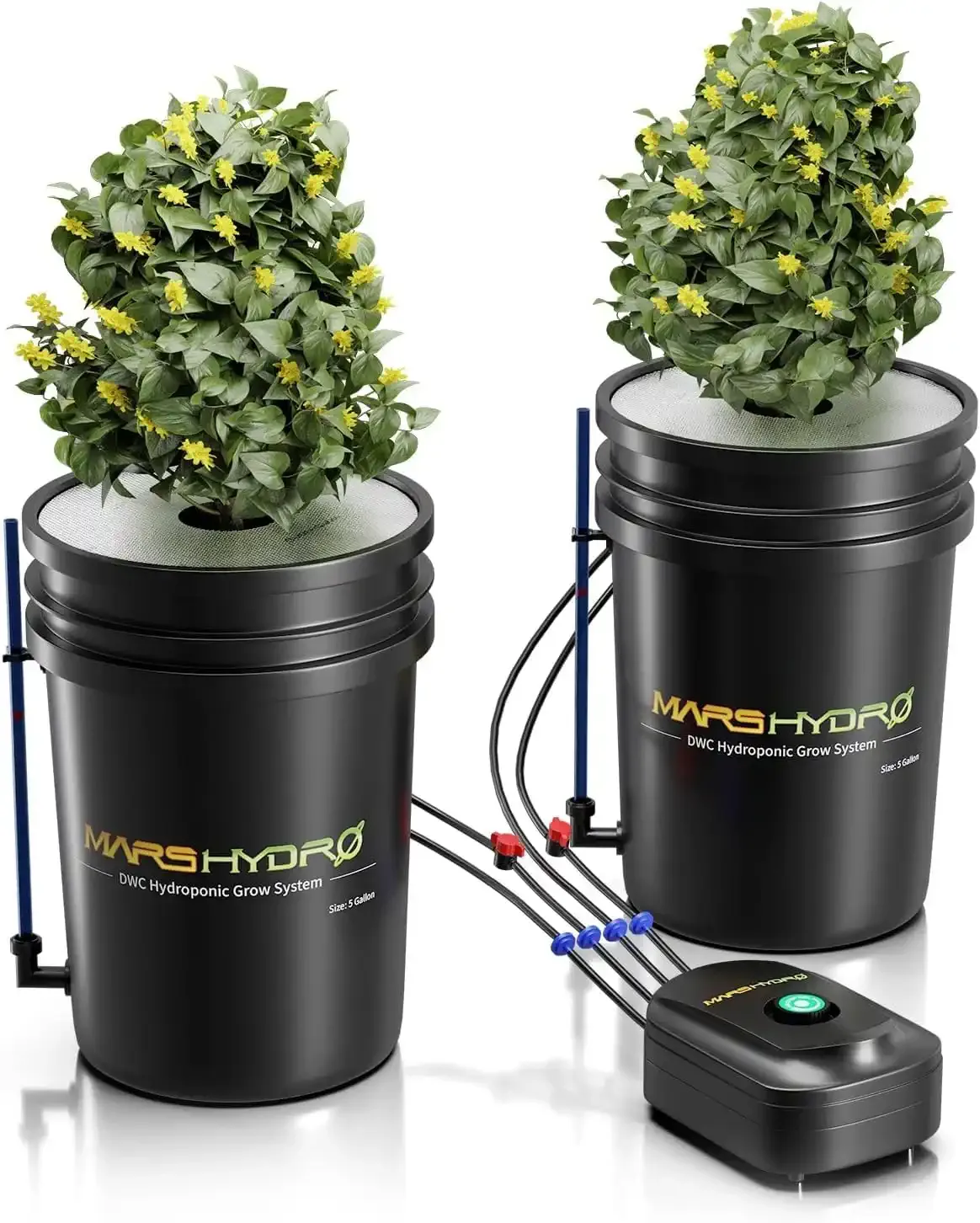
Mars Hydro Drip Hydroponics Grow System
DWC-based multi-bucket configuration with quiet diaphragm air pump and reinforced fittings. Provides durable, leak-free performance for heavy-feeding fruiting plants.
5. Wick Systems
The Wick system is an entirely passive hydroponic design operating without pumps, timers, or electrical connections.
Mechanics: An absorbent fabric wick connects the root container to an underlying nutrient reservoir. Capillary action draws solution upward into the growing media (perlite, vermiculite, or coco coir), maintaining constant moisture around the root crown.
Target Crops: Small, drought-tolerant culinary herbs (thyme, rosemary, oregano) and compact salad greens.
Advantages:
- No moving parts, electrical consumption, or mechanical noise.
- Lowest cost configuration to assemble.
- Resilient against power interruptions.
Limitations:
- Passive capillary flow cannot supply high-transpiration crops like fruiting tomatoes.
- Mineral salts accumulate in the upper substrate layers over time.
Operational Rule: Use synthetic braided nylon or polyester cord. Natural cotton wicks degrade and rot within weeks of continuous moisture exposure.
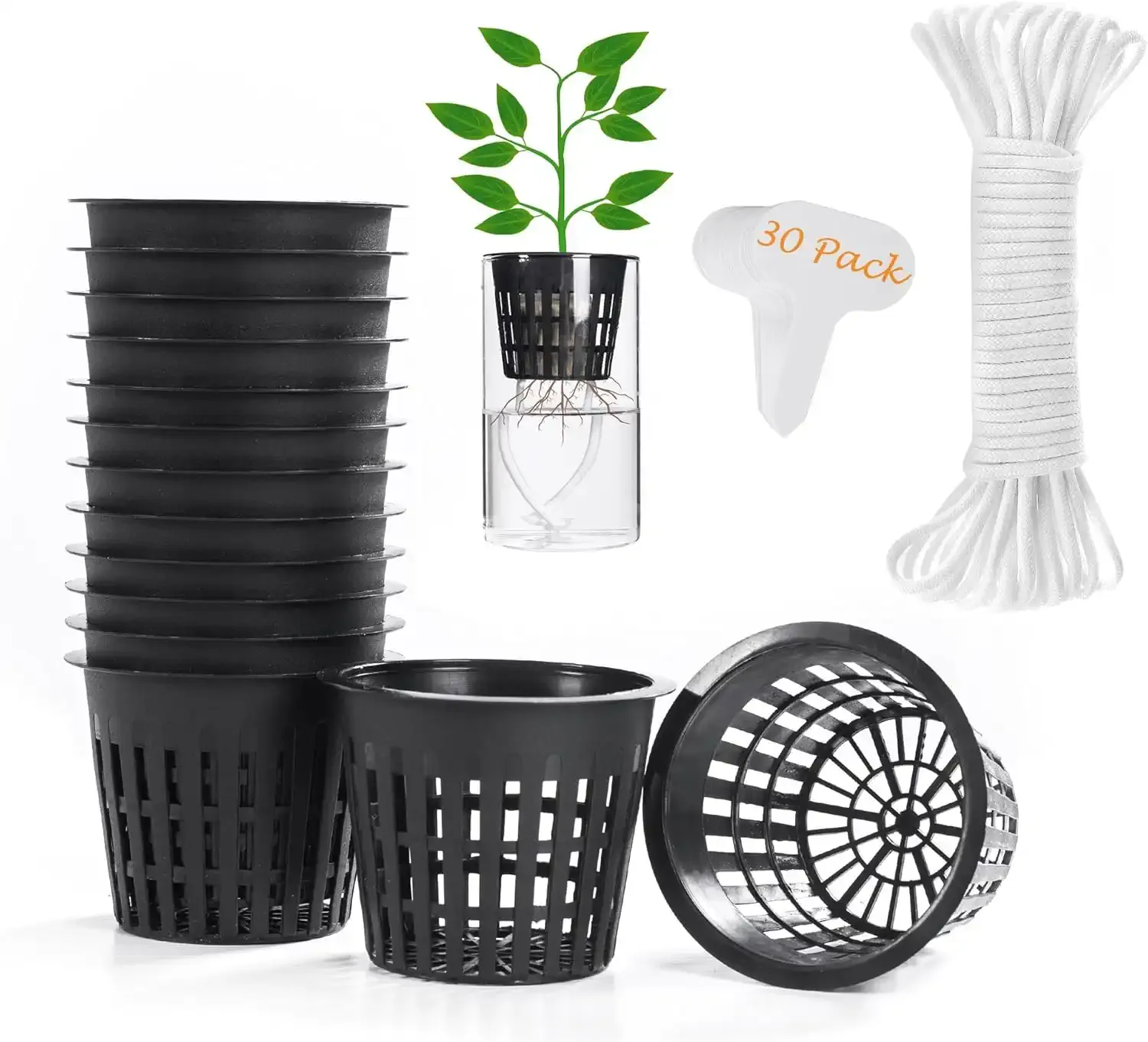
Self-Watering Planter Wick System Kit
Passive wicking planter operating without power or pumps. Suited for compact windowsill culinary herbs like basil and parsley.
Maintain strict reservoir chemistry regardless of system type. Review our guide on Understanding Hydroponic pH Levels and How to Manage Them to keep nutrients bioavailable.
Conclusion
Match the system to your crop requirements and maintenance schedule. For compact leafy greens with minimal hardware, start with passive Kratky or single-bucket DWC. For high-volume greens, build an NFT channel rack. For large fruiting vegetables, choose Ebb and Flow or drip emitters.
Before assembling hardware, read Common Hydroponic Mistakes to Avoid to ensure proper light sealing, water temperature control, and nutrient balancing.
Editor’s Note: Parts of this guide were structured and optimized with the assistance of AI, then thoroughly reviewed, edited and expanded with first-hand growing experience by our author Raymond to ensure practical, real-world accuracy.
Frequently Asked Questions
Which hydroponic system is easiest for beginners?
The passive Kratky method, wick systems, and single-bucket DWC setups are the simplest to assemble and operate. They use few or no mechanical parts and require minimal plumbing.
What is the primary benefit of Deep Water Culture (DWC)?
DWC submerges roots directly into an aerated nutrient bath. Continuous oxygenation from air stones prevents root suffocation and accelerates vegetative foliage growth.
Our Amazon Storefront
Browse all our recommended tools & supplies
Everything we personally use and trust, hand-picked for gardeners like you.

I've been running DWC and Kratky systems for several years and write about what actually works, not textbook theory. Follow along for honest product reviews, practical guides and real grow results.