As an Amazon Associate, I earn from qualifying purchases. Some links in this article are affiliate links, if you buy through them I may earn a small commission at no extra cost to you.
Quick Summary
- Soil-Free Basics: Hydroponics feeds plants directly using mineral-rich water solutions.
- Key Benefits: Conserves up to 90% more water and accelerates crop growth by 30–50% over in-ground beds.
- System Varieties: Choose between DWC, Kratky, NFT, Ebb & Flow, and Drip configurations.
- Reservoir Control: Keep pH between 5.5 and 6.5 and check EC concentration regularly for nutrient uptake.
- Lighting Strategy: Provide 14–16 hours of daily grow light exposure for indoor crops.
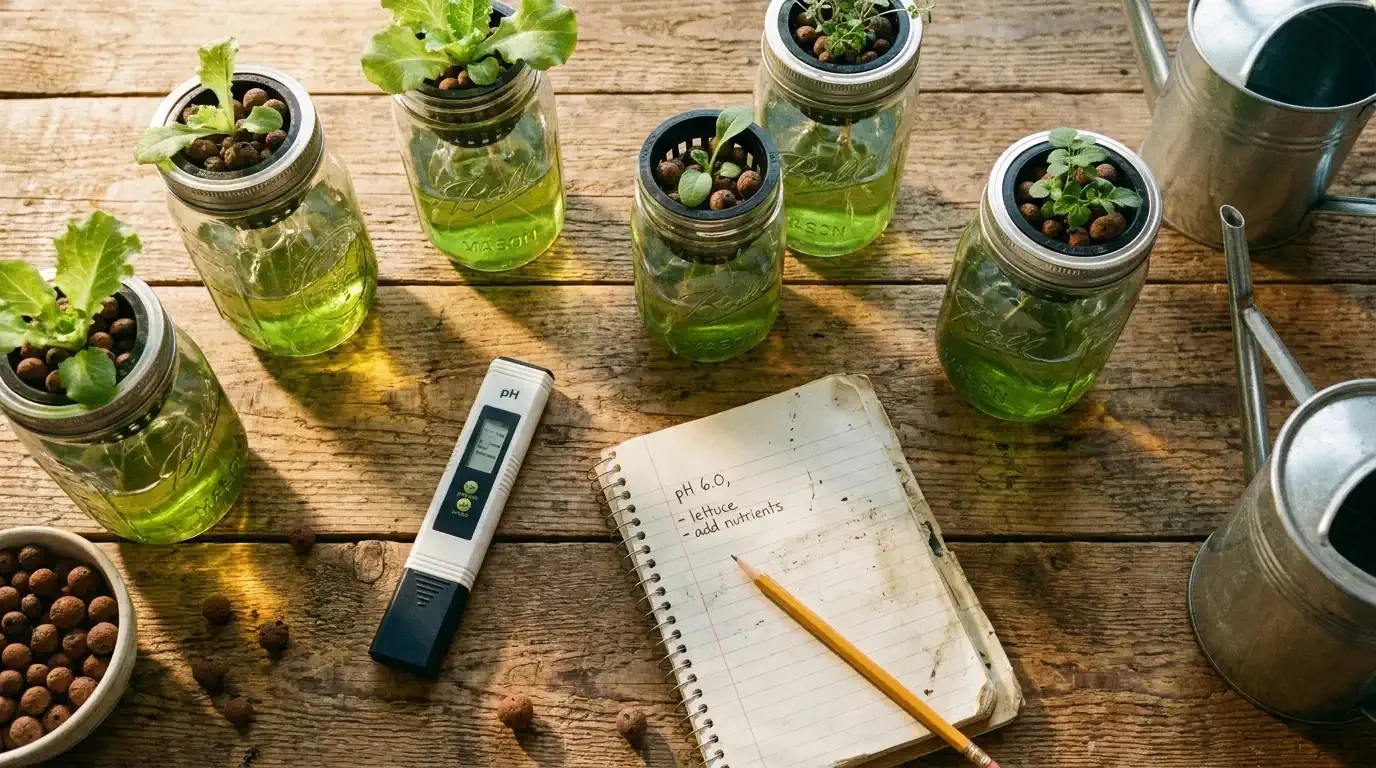
I started hydroponics six years ago after killing houseplants for years. When a friend suggested growing food without soil, I doubted it. I tried it anyway with a mason jar, lettuce seeds, and a nutrient solution mixed on the kitchen counter.
This guide covers three beginner systems, essential equipment, and daily reservoir maintenance. It is straightforward once you know the parameters.
What is Hydroponics?
Hydroponics is gardening without soil. Plants grow directly in water mixed with dissolved mineral nutrients. You can set up a system indoors, in a basement, or inside a small apartment.
Three primary designs suit beginners:
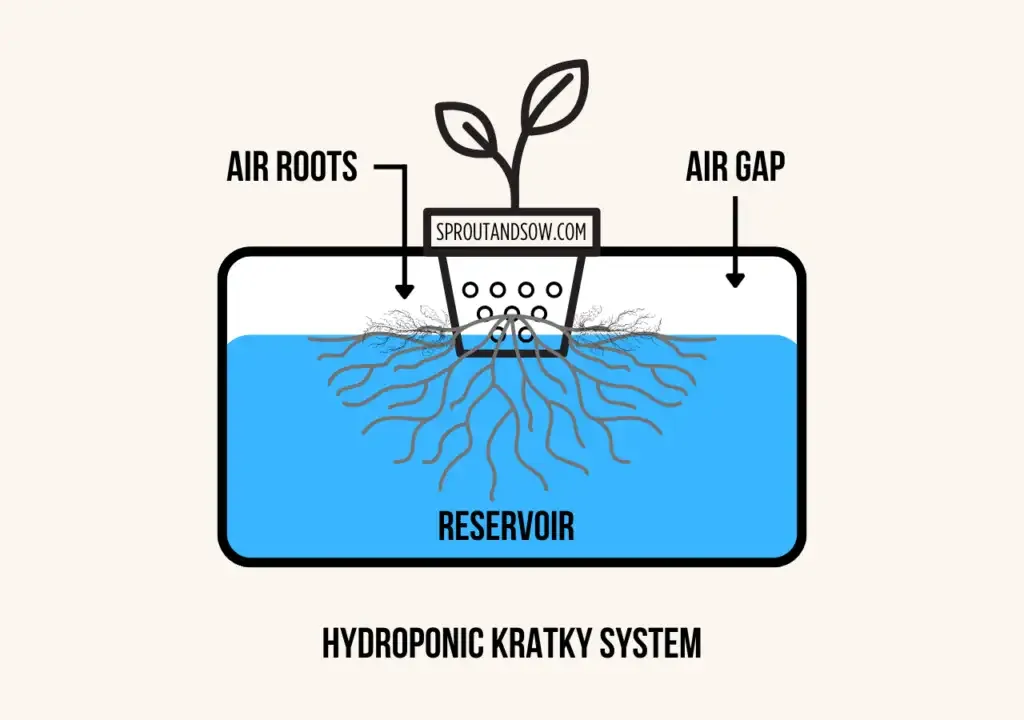
The Kratky Method is passive. Plants sit in net pots above a container of water and nutrients. As the plant absorbs water, the liquid level drops, creating an air gap that allows upper roots to take in oxygen. The system requires no pumps or electricity. When I first tested Kratky with lettuce, I overdosed the nutrient mix and burned the leaves. Follow the dilution rates on the bottle.
Never let the reservoir run dry. If the root zone dries out, the plant wilts quickly without early warning. Top up the reservoir with plain, pH-adjusted water once the volume drops past two-thirds.
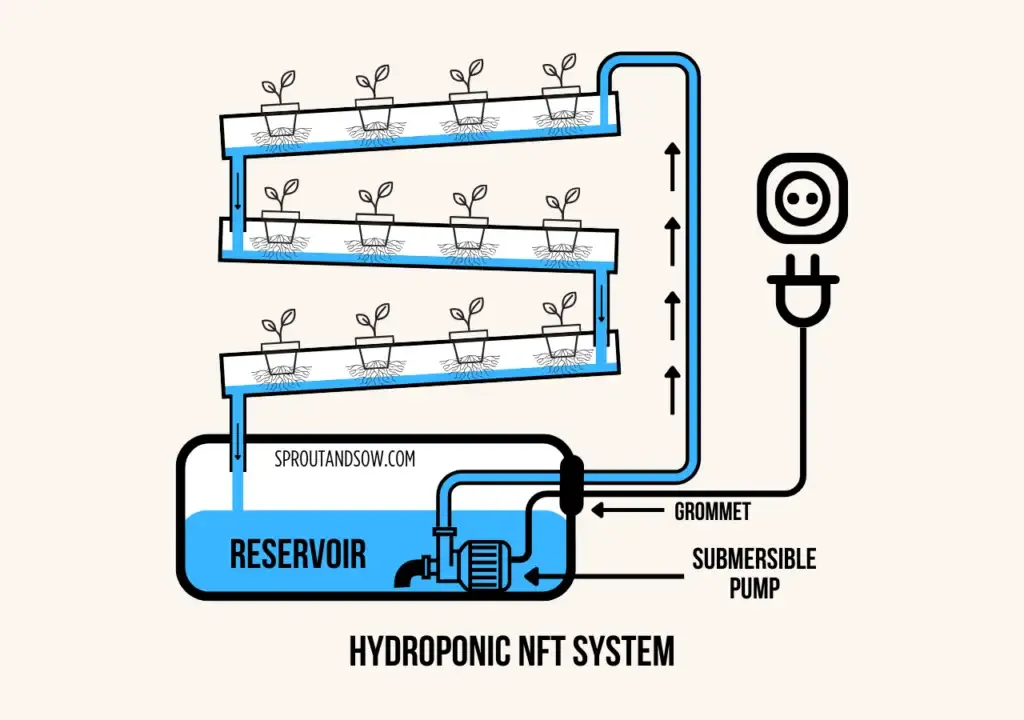
The Nutrient Film Technique (NFT) recirculates a shallow stream of nutrient solution over plant roots inside a sloped channel. Roots absorb nutrients from the flowing stream and oxygen from the humid air inside the channel. The setup requires a submersible pump and a timer. Basil and leafy greens grow rapidly in NFT channels.
The pump is the single point of failure in an NFT channel. If the pump stops, roots dry out within hours. Keep a spare water pump on hand as backup.
In a Deep Water Culture (DWC) system, plants sit in net pots suspended above a reservoir, with roots submerged in an aerated nutrient solution. An air pump connected to an air stone delivers dissolved oxygen directly to the water. DWC supports heavy-feeding crops like tomatoes and peppers.
DWC systems risk root rot when dissolved oxygen drops or water temperatures exceed 75°F (24°C). The roots turn brown and slimy. Run the air pump continuously and monitor reservoir temperatures with an aquarium thermometer.
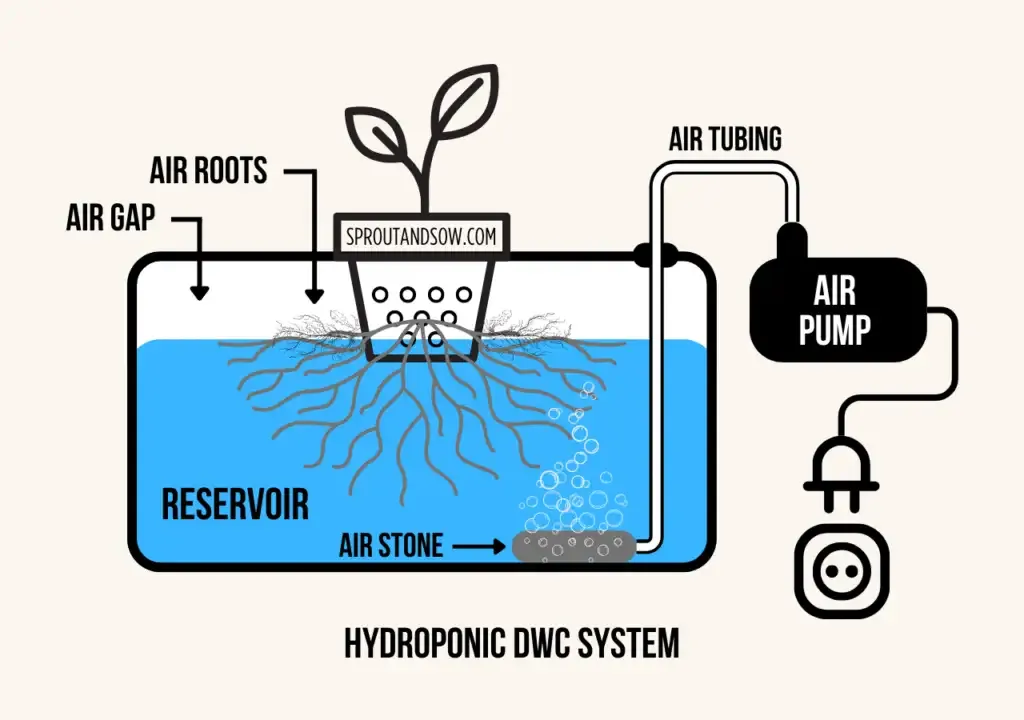
Choose Kratky for simplicity, NFT for high-volume leafy greens, or DWC for larger fruiting crops.
Benefits of Hydroponic Gardening
Hydroponic crops grow 30–50% faster than soil-grown plants. In soil, root systems expend energy pushing through dirt to seek minerals. In a hydroponic reservoir, dissolved nutrients bathe the root zone directly. The plant directs its energy into upward vegetative growth. A controlled study comparing Swiss chard grown in soil versus hydroponics found a higher relative growth rate in the hydroponic group under identical light conditions, which researchers attributed to direct nutrient availability and reduced root stress.
Hydroponics recirculates water in closed loops, cutting water consumption by up to 90% compared to open soil. A study by Barbosa et al. (2015) in the International Journal of Environmental Research and Public Health found a 12.5-fold reduction in water use per kilogram of lettuce compared to conventional farming. Indoor hydroponics also eliminates weeds and soil-dwelling pests like nematodes and root aphids.
Vertical hydroponic systems stack growing channels, producing higher yields per square foot than horizontal garden beds. This footprint makes indoor farming practical in apartments and garages.
Choosing the Right System for Beginners
System Comparison Dashboard
Choose the right system based on your budget, space limits, and crop goals.
| System | Cost | Maint. | Oxygen Source | Best For | Primary Risk |
|---|---|---|---|---|---|
Kratky Method | $ | Very Low | Passive air gap (roots hang in air space above nutrient solution) | Herbs, lettuce, small indoor spaces, first-time growers | Silent dry-out. If the reservoir runs completely dry, roots desiccate and the plant dies quickly without warning. |
Nutrient Film Technique (NFT) | $$ | Medium | Flowing film (roots receive constant flow of shallow, aerated water) | Continuous leafy green production, growers with moderate space | Pump failure or channel clog. If the pump stops or channels get blocked by roots, crops can dry out and be lost in hours. |
Deep Water Culture (DWC) | $$ | Medium | Active aeration (roots sit in solution oxygenated by an air pump) | Fruiting plants (tomatoes, peppers), larger setups, active monitors | Root rot. Roots are submerged constantly; if oxygen drops or water temperatures exceed 75°F (24°C), fungal rot sets in fast. |
Passive air gap (roots hang in air space above nutrient solution)
Herbs, lettuce, small indoor spaces, first-time growers
Silent dry-out. If the reservoir runs completely dry, roots desiccate and the plant dies quickly without warning.
Flowing film (roots receive constant flow of shallow, aerated water)
Continuous leafy green production, growers with moderate space
Pump failure or channel clog. If the pump stops or channels get blocked by roots, crops can dry out and be lost in hours.
Active aeration (roots sit in solution oxygenated by an air pump)
Fruiting plants (tomatoes, peppers), larger setups, active monitors
Root rot. Roots are submerged constantly; if oxygen drops or water temperatures exceed 75°F (24°C), fungal rot sets in fast.
Quick decision guide:
- Limited space, no pump budget, growing herbs or lettuce: Kratky
- Continuous greens, moderate space: NFT
- Fruiting plants (tomatoes, peppers), willing to monitor closely: DWC
If unsure, start with Kratky. Scale up to active pump systems once you understand nutrient management.
Choosing Seeds for Hydroponics
Leafy greens like lettuce, spinach, and Swiss chard thrive in beginner setups due to their shallow root systems. Bibb, buttercrunch, and romaine reach harvest in 30 days, roughly half the time required in soil. Herbs like basil, mint, and cilantro absorb nutrients efficiently, with basil growing up to 25% faster than in ground soil. Herbs like dill and oregano expand rapidly and require pruning or wider spacing in the system.
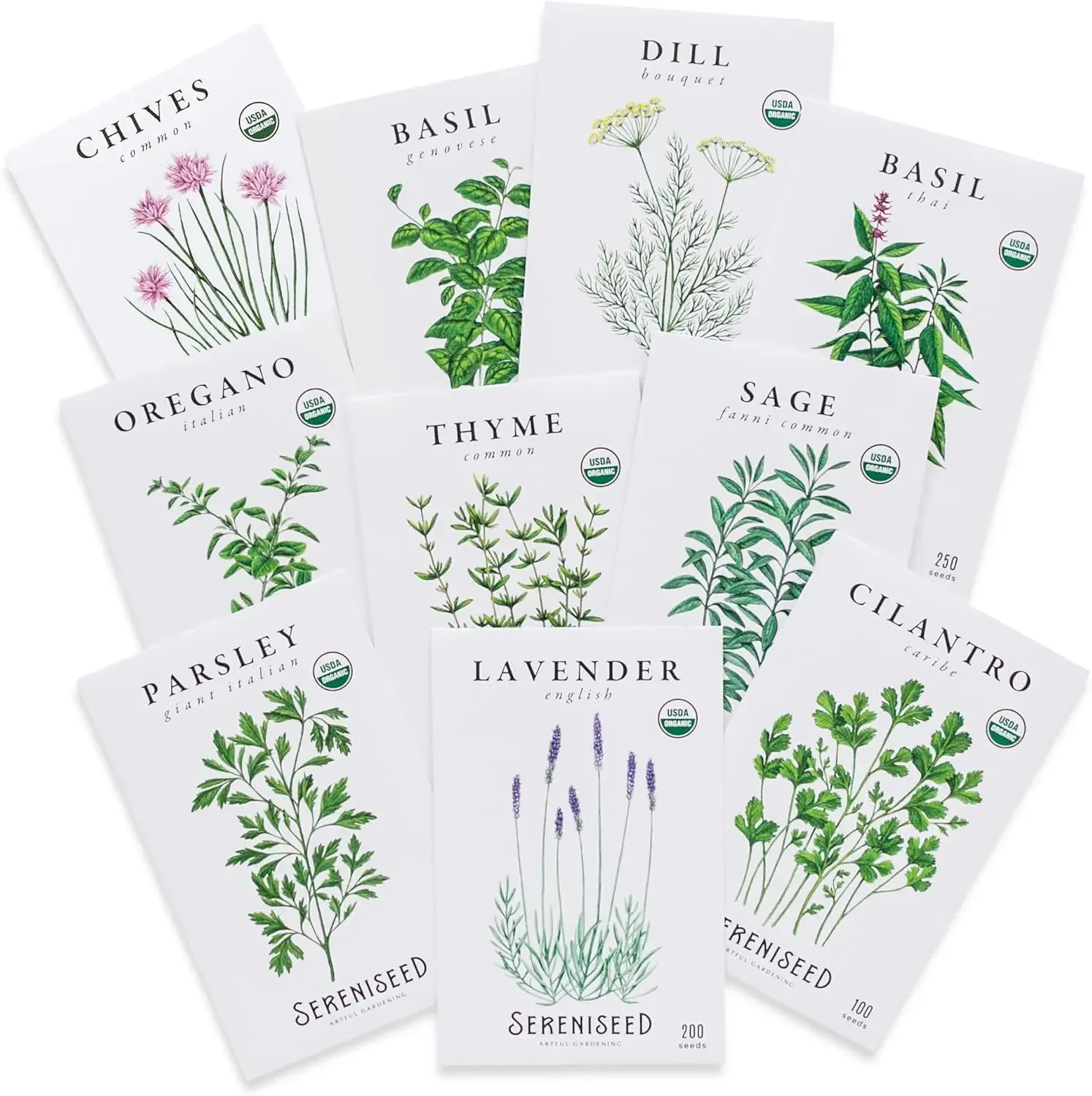
Certified Organic Herb Seeds
Basil, Cilantro, Oregano, Thyme, Parsley, Lavender, Chives, Sage, Dill Seeds for Indoor & Outdoor Planting. 10-Pack.
Fruiting plants like cherry tomatoes and strawberries demand higher light intensity and stronger nutrient concentrations. Indeterminate tomatoes require vertical trellising or string supports to hold fruit clusters as they mature.
Essential Equipment and Supplies
Every hydroponic system requires four core components: an opaque reservoir, mineral nutrients, a calibrated pH meter, and grow lights if natural light is inadequate. Skimping on a digital pH meter leads to nutrient lockout, as plants cannot absorb minerals outside specific pH boundaries.
To get your seeds started, pick up a starter seed trayView on Amazon, which improves germination rates over direct seeding into net cups.
For lighting, check out our beginner’s guide to the best LED grow lights, which provide efficient, full-spectrum illumination. Connect the lights to a digital timer to provide consistent 14 to 16 hour photoperiods.
Hydroponic fertilizer mixes supply macronutrients (nitrogen, phosphorus, potassium) and micronutrients (calcium, magnesium, iron). Mix strictly according to the manufacturer’s dilution ratios to prevent leaf tip burn.
For growing medium, you have three primary options:
- Coco coir (coconut husk fibres): naturally pathogen-free, retains water well, and buffers moisture. Soak it for 24 hours before use. A 70/30 coco-to-perlite blend balances moisture retention and aeration.
- Rockwool (melted basalt spun into fibres): holds water and air well, widely used commercially. Rockwool sits at an alkaline pH, so soak and pH-adjust it before planting. It is not biodegradable.
- LECA (expanded clay pellets): reusable, pH-neutral, drains well, and resists compaction.
Related: 10 Must-Have Tools for a Successful Hydroponic Garden: a breakdown of net pots, air stones, and timers that simplify daily operation.
A Note on Tap Water
Municipal tap water works for most setups, provided you account for water treatment chemicals:
- Chlorine vs. chloramine: Chlorine dissipates when left in an open bucket for 24 to 48 hours. Chloramine does not evaporate; remove it using a carbon block filter or a liquid dechlorinator. Check your local water utility report to determine which chemical is present.
- Hardness and TDS: Water with total dissolved solids (TDS) above 200 ppm can alter nutrient balance and cause pH drift. If source water TDS is excessive, use reverse osmosis (RO) or filtered water.
If you have municipal water treated with chlorine, letting it sit uncovered for 48 hours before mixing nutrients removes the disinfectant.
Setting Up Your First Hydroponic Garden
Position the system on a level, water-safe surface near a grounded electrical outlet. Running pumps and grow lights requires accessible power; keep power strips elevated off the floor to protect against splashes.
Fill the reservoir with water. For Kratky systems, leave a 1- to 2-inch air gap beneath the net pots once roots establish. For DWC, keep the waterline touching the base of the net pot until roots drop into the bath. Mix nutrients into the water thoroughly before checking conductivity. Never exceed recommended label rates; excess salts draw moisture out of plant tissues, causing leaf scorch.
Maintain pH between 5.5 and 6.5. Outside this range, essential minerals precipitate or become chemically unavailable: iron and zinc lock out above 6.5, while calcium and magnesium lockout occurs below 5.5. Plants develop deficiencies even in nutrient-rich water. Adjust the reservoir using dilute phosphoric acid (pH Down) or potassium hydroxide (pH Up). For technical specifications, see Oklahoma State University’s hydroponic guide on EC and pH.
For indoor gardens, position full-spectrum LED fixtures above the canopy:
- Leafy greens (lettuce, spinach, kale): 12–16 hours daily.
- Fruiting crops (tomatoes, peppers): 16–18 hours daily during vegetative growth, shifting spectrum toward red (620–660 nm) during flowering.
Maintain lights 18–24 inches above seedlings and 12–18 inches above mature canopies to prevent photobleaching and leggy stems.
Related: Understanding Hydroponic pH Levels and How to Manage Them: a detailed guide to adjusting pH balance and recognizing early signs of nutrient lockout.
Nutrient Solutions: Feeding Your Plants Right
Hydroponic fertilizer formulas supply primary macronutrients: nitrogen (N), phosphorus (P), and potassium (K), along with secondary nutrients (calcium, magnesium, sulfur) and chelated trace elements. Pre-formulated commercial nutrient lines simplify balancing; consult our guide to choosing the best hydroponic nutrients to match fertilizer formulas with your specific crop.
Stick to a single nutrient brand and follow its feed schedule. Mixing products from different manufacturers often causes nutrient antagonisms and salt precipitation.
Verify concentration using an Electrical Conductivity (EC) or Total Dissolved Solids (TDS) meter. These meters measure total dissolved mineral ions in solution:
| Plant | Target EC (mS/cm) | Target pH |
|---|---|---|
| Lettuce | 0.8–1.2 | 5.5–6.0 |
| Leafy greens | 1.2–2.0 | 5.5–6.5 |
| Tomatoes / peppers | 2.0–3.5 | 5.5–6.5 |
If lettuce exhibits brown, dry margins (tip burn), measure EC before altering other parameters. At levels above 1.2 mS/cm, dilute the reservoir with plain, pH-adjusted water. High salt concentration causes tip burn more frequently than calcium deficiency.
Test pH every two to three days. Root uptake changes the chemical equilibrium of the solution, causing regular pH drift.
Daily Care and Maintenance Tips
Follow a daily maintenance routine to catch reservoir issues before crops suffer:
- Water Level: Check water levels daily. Mature plants transpire water faster than they consume salts. Top off with plain, dechlorinated water between complete reservoir flushes to avoid salt spikes.
- Algae Prevention: Algae consumes dissolved oxygen and competes for nutrients. Exclude all light from reservoirs, channels, and plumbing lines. Use black or opaque containers and opaque vinyl tubing. If algae forms, flush the system with dilute 3% food-grade hydrogen peroxide and seal light leaks.
- pH Verification: Test pH every 48 hours to maintain nutrient uptake availability.
Related: Common Hydroponic Pests and How to Manage Them: how to spot, prevent, and treat indoor intruders like aphids, fungus gnats, and spider mites.
Growing Different Plants
Begin with crops suited to your setup. Leafy greens and compact herbs require minimal space and lower lighting wattage:
- Lettuce and Greens: Varieties like Bibb, Butterhead, and Romaine mature within 30 days in hydroponic systems, compared to 60 days in outdoor soil. Use a cut-and-come-again harvesting technique to harvest outer leaves continuously.
- Culinary Herbs: Basil, mint, and cilantro establish rapidly. Basil grows aggressively under 16 hours of daily light; prune terminal shoots weekly to encourage bushy lateral growth and prevent premature flowering.
Cost of Starting a Hydroponic Garden
Starting costs depend on system complexity. Read our guide on how much it costs to build an affordable hydroponic system for a full component breakdown:
- Kratky Setup: $15–$30 using repurposed food-grade buckets, net cups, and basic nutrients.
- Deep Water Culture (DWC): $60–$100 including an air pump, air stones, tubing, net pots, and grow light.
- Turnkey Systems: $80–$250 for integrated countertop units with automated LED timers and water circulators.
Ongoing operational costs include dry or liquid nutrient concentrate ($10–$20 every few months) and minimal electricity for LED lighting (typically $3–$8 per month depending on local kilowatt-hour rates).
Common Challenges and How to Overcome Them
Nutrient Deficiencies
Yellowing between leaf veins (interveinal chlorosis) indicates iron or magnesium deficiency, often triggered by high pH lockout rather than mineral absence. Test and adjust pH before adding more fertilizer.
Root Rot
Root rot occurs when water temperature exceeds 75°F (24°C) or dissolved oxygen drops. Read our guide on the importance of air pumping in hydroponics for aeration benchmarks. Healthy roots are firm and white; infected roots turn brown, soft, and foul-smelling. Prevention is critical: maintain reservoir temperature between 65°F and 70°F (18°C–21°C) and run aerators continuously. Once rot takes hold, sanitize the reservoir with hydrogen peroxide or discard infected roots.
Rapid pH Swings
Small reservoirs (under 5 gallons) swing rapidly in pH as plants consume water and ionic nutrients. Choose larger reservoirs to buffer chemical stability, and test pH every two days.
Related: How to Troubleshoot Common Hydroponic Problems: a diagnostic guide for yellowing leaves, slow growth, and root odors.
Editor’s Note: Parts of this guide were structured and optimized with the assistance of AI, then thoroughly reviewed, edited and expanded with first-hand growing experience by our author Raymond to ensure practical, real-world accuracy.
Frequently Asked Questions
Is hydroponic food safe and organic?
Hydroponic produce is clean and safe, containing the same minerals as soil-grown crops. You can practice organic hydroponics using OMRI-listed organic liquid nutrients.
How much water does hydroponics save?
Hydroponics recirculates water in closed reservoirs, saving up to 90% more water than traditional soil gardening where runoff drains into the subsoil.
Our Amazon Storefront
Browse all our recommended tools & supplies
Everything we personally use and trust, hand-picked for gardeners like you.

I've been running DWC and Kratky systems for several years and write about what actually works, not textbook theory. Follow along for honest product reviews, practical guides and real grow results.